IChapter
Up to the Estates-General
Latest
French Revolution Actors
Translation in progress
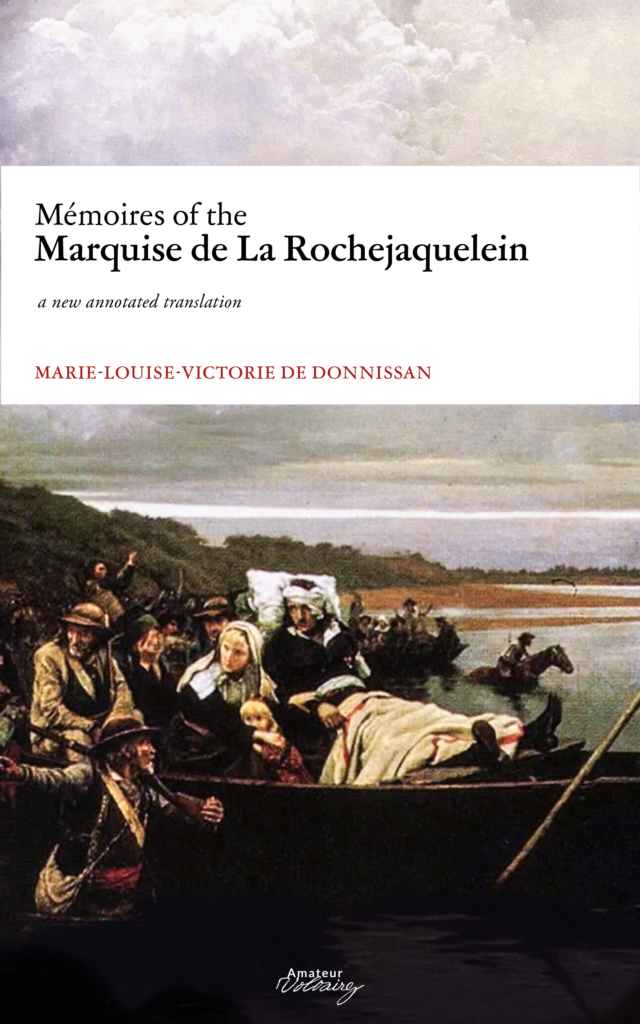
by Marie-Louise-Victoire de Donnissan de La Rochejaquelein · translated from the French by Alexandra Lam
"I am but twenty-six years of age, yet I feel as though I have already lived for centuries, and the Revolution is not yet over…"
The Memoirs of the Marquise de La Rochejaquelein is a stark, firsthand account of the Vendean War during the French Revolution, written by a woman who was both a witness to the conflict and one of its victims. Born at Versailles and raised amid the splendour of the royal court, Marie-Louise-Victoire de Donnissan’s life was overturned when she married the Marquis de Lescure and found herself at the centre of the Catholic uprising in the Vendée. Originally written as a private record and as a way of reckoning with the trauma of the war, the book has, since its publication in 1814, become the key testimony of the Vendean epic: the account that fixed its narrative for the next two hundred years.
Original
French
Length
28 chapters
~20,000 words
Available
0 of 28
Reading time
~2 hours
full work
About this translation
The War in the Vendée was one of the French Revolution’s most dramatic and unsettling episodes. It was the bloodiest conflict of the Revolution, but that is not the whole measure of its significance. It also forces us to ask how far a revolutionary government may go in the name of public safety; what happens when popular sovereignty confronts an armed people who reject the Revolution; and how civil war transforms ordinary communities into enemies.
The Mémoires de Madame la marquise de La Rochejaquelein is one of the central testimonies of this conflict. Written by Victoire de Donnissan, Marquise de Lescure and later Marquise de La Rochejaquelein, the book recounts the war from within the Vendéan world, from the position of a woman married to one of the army’s main generals. Her account follows the collapse of court society, the violence of the Revolution, the rising in the Bocage, the campaigns of 1793, the crossing of the Loire, defeat, flight, imprisonment, bereavement, and survival.
In the nineteenth century, Madame de La Rochejaquelein’s book was not just an account of the war in the Vendée. For many readers, it was the Vendée. The first published version, prepared with the help of Prosper de Barante and issued at the end of 1814, became a European success, with numerous French editions and foreign translations. Yet that version was also shaped, polished, shortened, and made more acceptable to contemporary readers. Barante’s text remained the only version in circulation until 1889, when Victoire’s grandson, Julien de La Rochejaquelein, published a so-called autograph edition based on the original text, a commented copy from 1808, additions made by his grandmother to Barante’s manuscript, and notes preserved at the château de Clisson.
Julien wanted to restore his grandmother’s account without Barante’s political smoothing. He was not, however, a neutral editor. He was working almost ninety years after the text was written, and on the history of his own grandmother and family. With the typical proprieties of the late nineteenth century, he sometimes retouched, suppressed, cut, or added material. Even so, among the public-domain editions, his version remains the closest to the original text.
This commented translation follows the 1889 text of the memoirs, a version never before translated into English. It has been checked against the French edition established by historian Alain Gérard in 2010. The aim is to make the memoirs accessible to modern readers who know little about the Revolution and the war in the Vendée, without stripping away their complexity.
The commentary identifies people, places, battles, institutions, family relationships, political references, and textual variants. It explains where the author speaks from personal memory, where she relies on later testimony, where her account is partisan, and where later editors have altered the text. It also places her subjective experience beside two centuries of historical study, which offers a less partial, though never perfectly neutral, view of events.
The purpose of this edition is twofold: to let Victoire de La Rochejaquelein speak in English with as much clarity and immediacy as possible, and to give readers the historical framework needed to understand her. These memoirs should not be read as a simple royalist legend, nor dismissed as partisan nostalgia. They should be read critically, sympathetically, and intelligently: as the testimony of a woman living in extraordinary times, and as one of the foundational texts of counter-revolutionary memory.
Contents
0 available · 28 forthcoming