
A lovely person on Tumblr asked me whether Wikipedia was actually right about Henri de La Rochejaquelein being at the Tuileries on 10 August 1792, whether it really was his first battle, and, perhaps most importantly, how on earth he managed to survive it.
I was very happy to get the question, because if there’s one thing that makes him interesting, it’s that parts of his life read like an adventure novel. His escape from the Tuileries, and then from Paris itself, is very much one of those parts.
The short answer is that Wikipedia is roughly right: Henri de La Rochejaquelein was at the Tuileries on 10 August 1792, on the king’s side, and he survived a day that killed a lot of people in broadly the same position. The “first battle” claim is only half true. He’d already had his “baptism of fire” in a small order-maintenance operation near Lauzun (Agenais) in 1790. That said, 10 August is his first experience of large-scale violence and real casualties.
The Royal Constitutional Guardsman
So first: what was the son of a provincial noble from fuck-nowhere Bas-Poitou doing at the Tuileries in the first place?
The short answer, again, is that in some bizarre way it was his job. As Wikipedia says, by late 1791 he’d agreed to enter the king’s Constitutional Guard as a cavalry sub-lieutenant under d’Hervilly 1. The King’s Constitutional Guard was a strange compromise: it let the king (whom people weren’t exactly fans of after Varennes) have some kind of day-to-day protection, while trying to reduce the risk it turned into a private royal army.
In principle the corps combined infantry and cavalry and was funded through the king’s Civil List (so paid as part of the monarchy’s household finances rather than as a line regiment). A commonly cited structure is 1,200 men on foot and 600 mounted, with the departments presenting candidates for the infantry while the king selected the mounted component. Its intended role was protective and ceremonial: guarding the royal apartments and escorting the royal family.
You don’t need to be a specialist in the French Revolution to see why this went down badly. After Varennes, a guard chosen by the king looked suspicious by definition. The Guard quickly acquired a reputation, fair or not, as an “aristocratic” body. Rumours circulated that it would be used to engineer a counter-revolutionary coup, or to facilitate a(nother) royal escape. It was also very clearly the queen’s project, right down to uniform choices, which tells you what sort of loyalty it demanded, what it was meant to represent, and why people in Paris weren’t thrilled.
So why did Henri actually join? The reason he ended up there is open to speculation, because while he’d been a soldier since thirteen in various units, this wasn’t an obvious career move. On the contrary. Service in the King’s Constitutional Guard didn’t offer the normal route of advancement in the wider army; promotion would largely be confined inside that body. So he plainly wasn’t doing it for some straightforward material purpose.
Whether he wanted it, or whether his father wanted it, is also up for speculation. When notified by the duc de Brissac 2 on 30 November 1791 that Louis XVI had named him to the corps, what we do know is that he didn’t accept instantly, since the Minister of War had to send a reminder on 16 December asking him to confirm by 1 January 1792 whether he intended to join. He does accept, and someone somewhere really wants him in, because there’s a small administrative detail that has to be fudged: the Guard required men to be between twenty and thirty. Henri was nineteen. His age is quietly adjusted by two years on the rolls so he meets the requirement. So either he, or someone acting for him, really wanted the boy to join.
But if you know anything about the short-lived King’s Constitutional Guard, you’ll look at me and ask: but umm… weren’t they disbanded in late May 1792?
Partially correct. Louis XVI accepted the dismissal of his guard, and the disarmament took place at the Tuileries, after which the former guards were publicly abused. That was the formal end of the corps.
The informal reality is that the guards, and some other nobles seen as loyal, were told to remain in Paris. Former members were effectively kept on standby and were still paid, still expected to respond if the king called on them. They were harassed in public to the point that officers advised them not to appear in uniform, so they continued to mount guard in civilian clothing.
Henri at the Tuileries
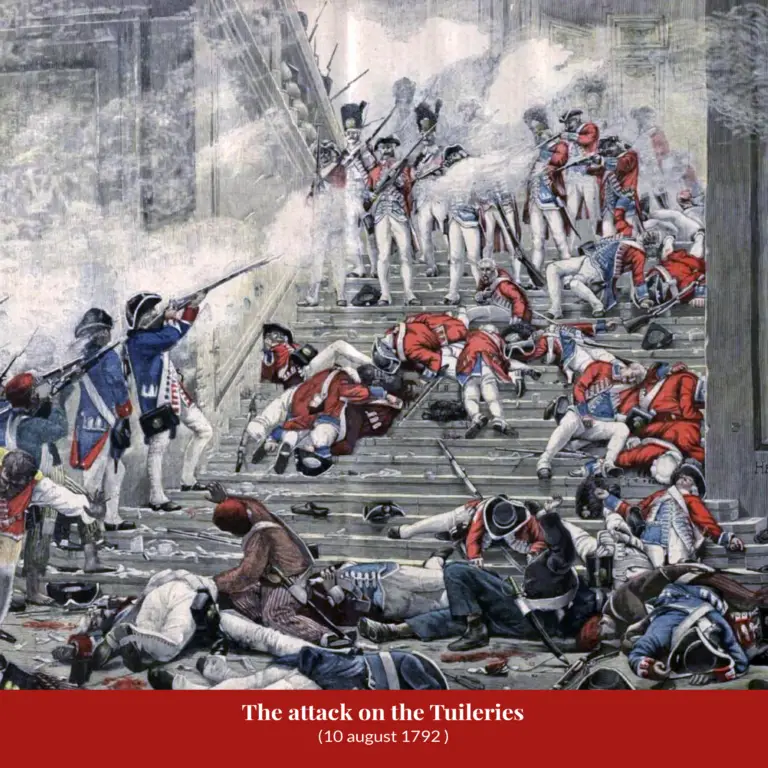
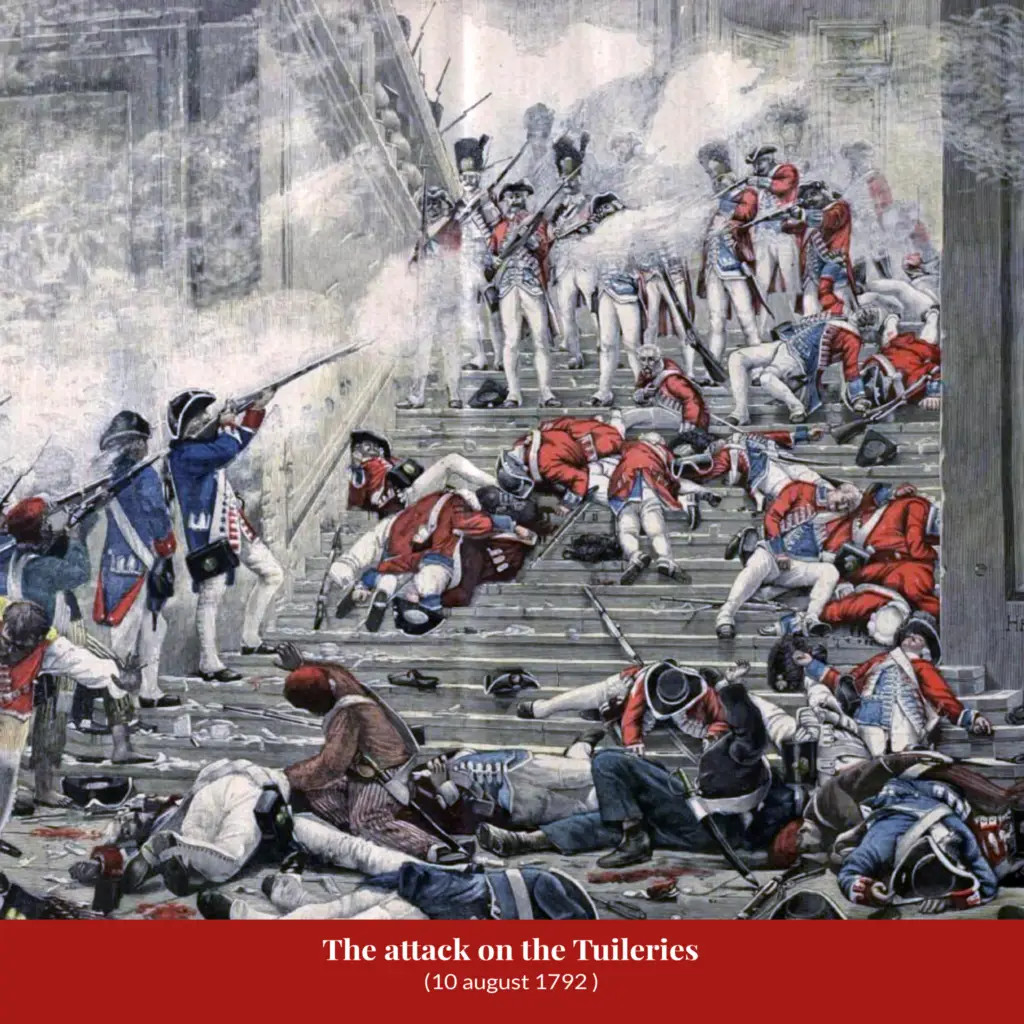
So: 10 August. As insurrection becomes imminent, Louis XVI calls in defenders: Swiss Guards, National Guardsmen of uncertain reliability, and former constitutional guardsmen now in plain clothes, plus various gentlemen who rush in because they genuinely believe defending the king is their duty. He calls them, but he doesn’t arm them properly, and he puts an eighty-year-old in charge.
Henri is placed with the group commanded by Vioméni 3l and d’Hervilly, posted inside the Tuileries in the Galerie des Carrosses. The night is tense and disorganised. The palace isn’t a fortress, the defenders are under-armed compared to what’s coming, and Louis XVI was many things, but decisive and martial he was not. As the situation tightens, Louis XVI chooses to leave the palace and go to the Assembly, believing, or being persuaded, that this will prevent bloodshed.
Various biographies report that Henri wanted to follow the king and was fairly vociferous about it. The king refuses, repeatedly, insisting only the National Guard will escort him. The queen orders the gentlemen to stay.
Once the royal family leaves the palace, the defenders’ position becomes hopeless. The attack begins. The Swiss fire and briefly hold the assailants back, but the king sends an order for the Swiss to cease fire, and they comply. Command then collapses, and different groups improvise exits or attempt to break out.
Henri, like many others, does the same. He reaches the river, detaches a boat, and crosses to the left bank, which is quieter. He briefly returns to his lodging, but decides it’s unsafe to stay: he’s known as a former member of the king’s Constitutional Guard and could be denounced.
The adventure of leaving Paris
By chance he finds a fellow guardsman, friend and future commander in the Vendée War, Charles d’Autichamps, who brings him to the house of another figure familiar to anyone interested in the Vendée, the marquis de Bonchamps, in the rue de Harlay. But Bonchamps is himself worried about being denounced, so this can’t be a stable refuge. Henri and d’Autichamps both know they need to leave Paris, but it’s not like they can just walk out. They need passports.
Enter another familiar figure, and Henri’s cousin: the marquis de Lescure, who is trying to secure passports through the local section. Lescure has the luck to run into Thomassin, his former governor, now a commander in the Paris National Guard and still personally loyal to him. Thomassin has obtained passports for Lescure and his wife, and he’s prepared to do the same for La Rochejaquelein and d’Autichamps, but procedure requires a lodging declaration and two witnesses to attest the applicants are housed where they claim. Lescure makes the declaration and finds a cooperative first witness; Thomassin brings a second.
When they all go to the Section du Roule, they’re delayed in a queue, and during the wait the second witness reads a posted warning that false witnesses will be punished with two years in irons. He panics, goes straight to the secretary, and admits he doesn’t know these men at all. When their turn finally comes, the secretary quietly tells Lescure, “You are lost, get out,” while outwardly fobbing them off with a complaint that he has no time and they must return later. They run, and they’re lucky they escape with their lives.
Lescure and his family manage to leave on 25 August, but Henri and d’Autichamps are still stuck. What saves them is a random guy, a lawyer, called Fleury, who somehow hides Henri and d’Autichamps in his home even though he doesn’t personally know them. To make matters more interesting, Fleury lives in the rue de l’Ancienne-Comédie, close to the Carmelite convent, one of the principal sites of the September Massacres.
Fortunately for the two of them, Paris can’t keep its barriers closed for long. Food shortages force the reopening of the barriers on 8 September. Henri and d’Autichamps leave as soon as it’s possible, reach Orléans, and travel on disguised as Loire boatmen to Sainte-Gemme near Ponts-de-Cé, a property connected to d’Autichamps’s family. After that, he goes back home to La Durbeliere.
Footnotes
- 1Louis Charles Le Cat, comte d’Hervilly (1756–1795) was a French noble officer who served under the monarchy and then became a counter-revolutionary émigré commander. He fought in the American Revolutionary War as an aide-de-camp to Admiral d’Estaing and was promoted maréchal de camp in 1792. Later, he was one of the leading figures in the failed émigré landing at Quiberon in 1795, after which he died in London from his wounds.
- 2Louis Hercule Timoléon de Cossé, duc de Brissac (1734–1792) was a senior court figure and military commander under Louis XV and Louis XVI, holding offices including captain-colonel of the Cent-Suisses (Swiss bodyguard company) and Grand Panetier of France. In 1791 he became commander-in-chief of the king’s Constitutional Guard, a post that made him a prominent target once the guard was dissolved in 1792. He was arrested and was killed during the September massacres in 1792.
- 3Antoine-Charles du Houx, baron de Vioménil (1728–1792) was a long-serving French general from Lorraine who fought in several wars, including the American War of Independence, where he served under Rochambeau and took part in the Yorktown campaign. During the Revolution he remained closely attached to Louis XVI and, on 10 August 1792, he was seriously wounded defending the king during the attack on the Tuileries. He died in Paris on 9 November 1792 from those wounds.
Sources & further reading
- Marquise de La Rochejaquelein Mémoires , 1814, 1889.
- Françoise de Chabot Henri de La Rochejaquelein , 1889.
- Baron de La Tousche, Monsieur Henri. Henri de La Rochejaquelein, 1948.