
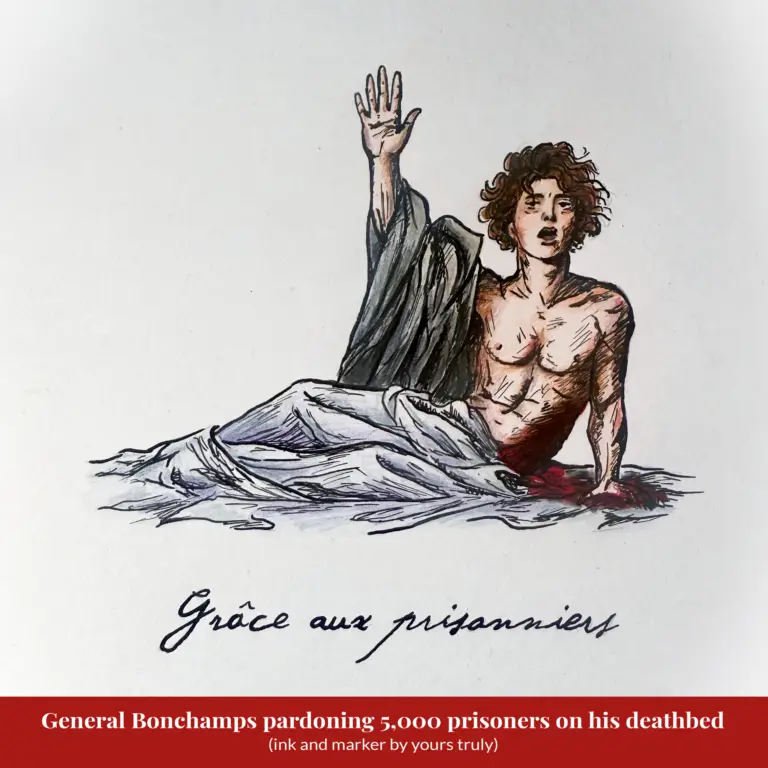
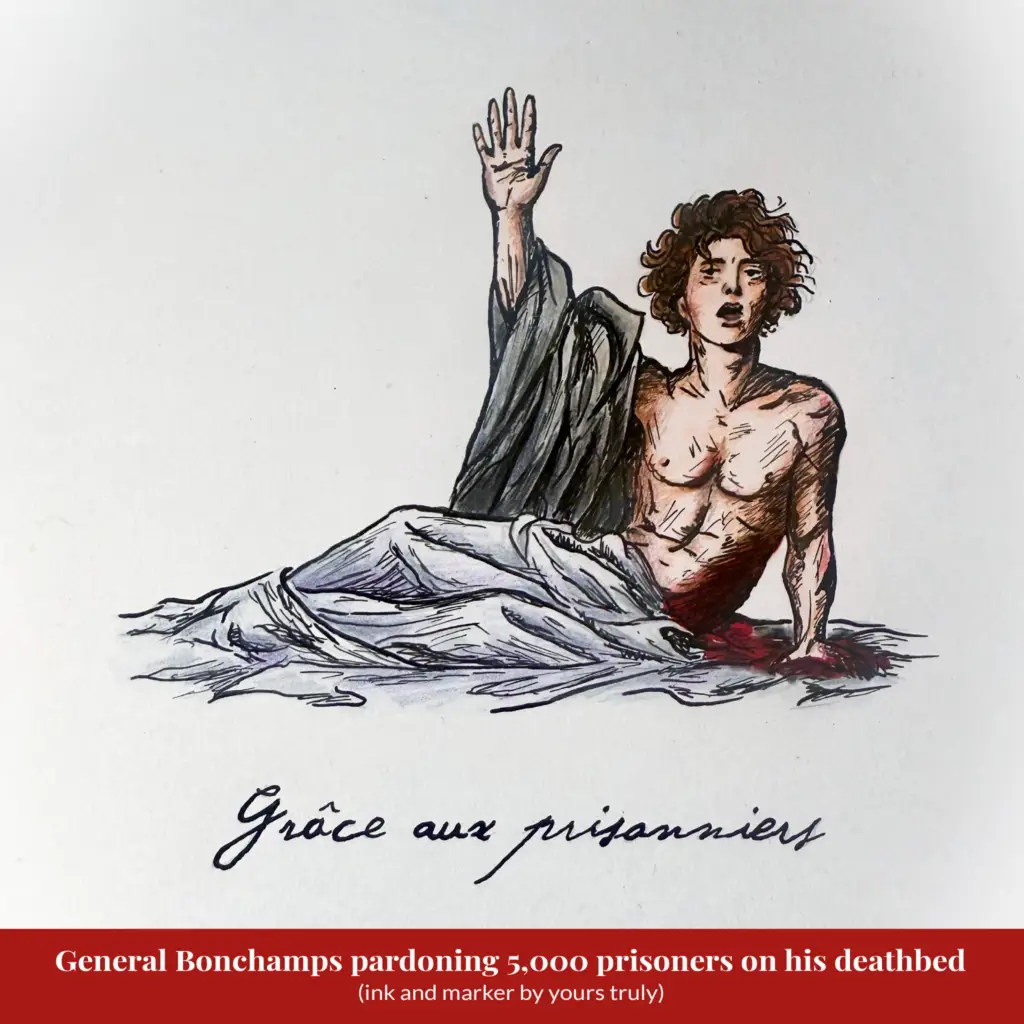
One of my favourite episodes of the Vendéan War is the death of General Charles de Bonchamps, mortally wounded after the Battle of Cholet and carried to Saint-Florent-le-Vieil.
It isn’t my favourite because I find Bonchamps particularly fascinating, or because of the inherent tragedy of it, nor even because it followed one of the war’s most decisive battles, but because it shows that humanity can exist even when violence has become routine.
On his deathbed, in unbearable pain, Bonchamps learned that the Republican prisoners, five thousand of them, were about to be executed. Horrified, he ordered their release. That was his final act as general. That gesture, made in the face of death, is , to me, profoundly humbling.
Charles-Melchior-Artus, Marquis de Bonchamps (1760–1793)
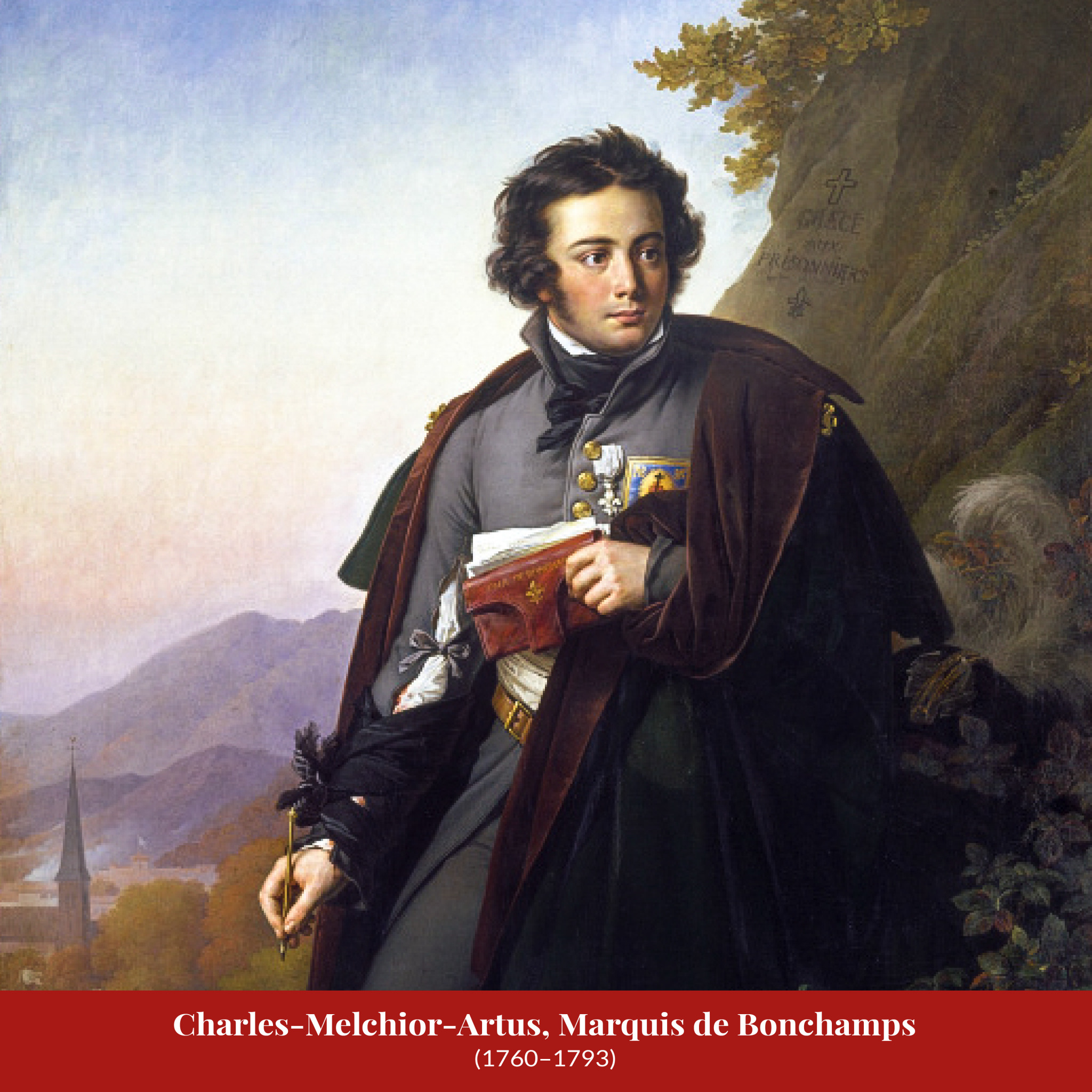
Charles-Melchior-Artus de Bonchamps was born on 10 May 1760 at Juvardeil, in the province of Anjou. His family belonged to the rural nobility of western France, respected but not wealthy. His father had served as a page at Versailles and left him only a modest inheritance, including a small family estate in what is now the department of Maine-et-Loire.
Bonchamps entered military service at sixteen, joining the Régiment d’Aquitaine in 1776. He showed early promise as an officer. During the American War of Independence, he was sent to India in 1782 as part of the French expeditionary forces supporting the Sultan of Mysore, Tipu Sahib, against the British. He returned to France in 1783, was promoted captain, and later stationed at Mézières.
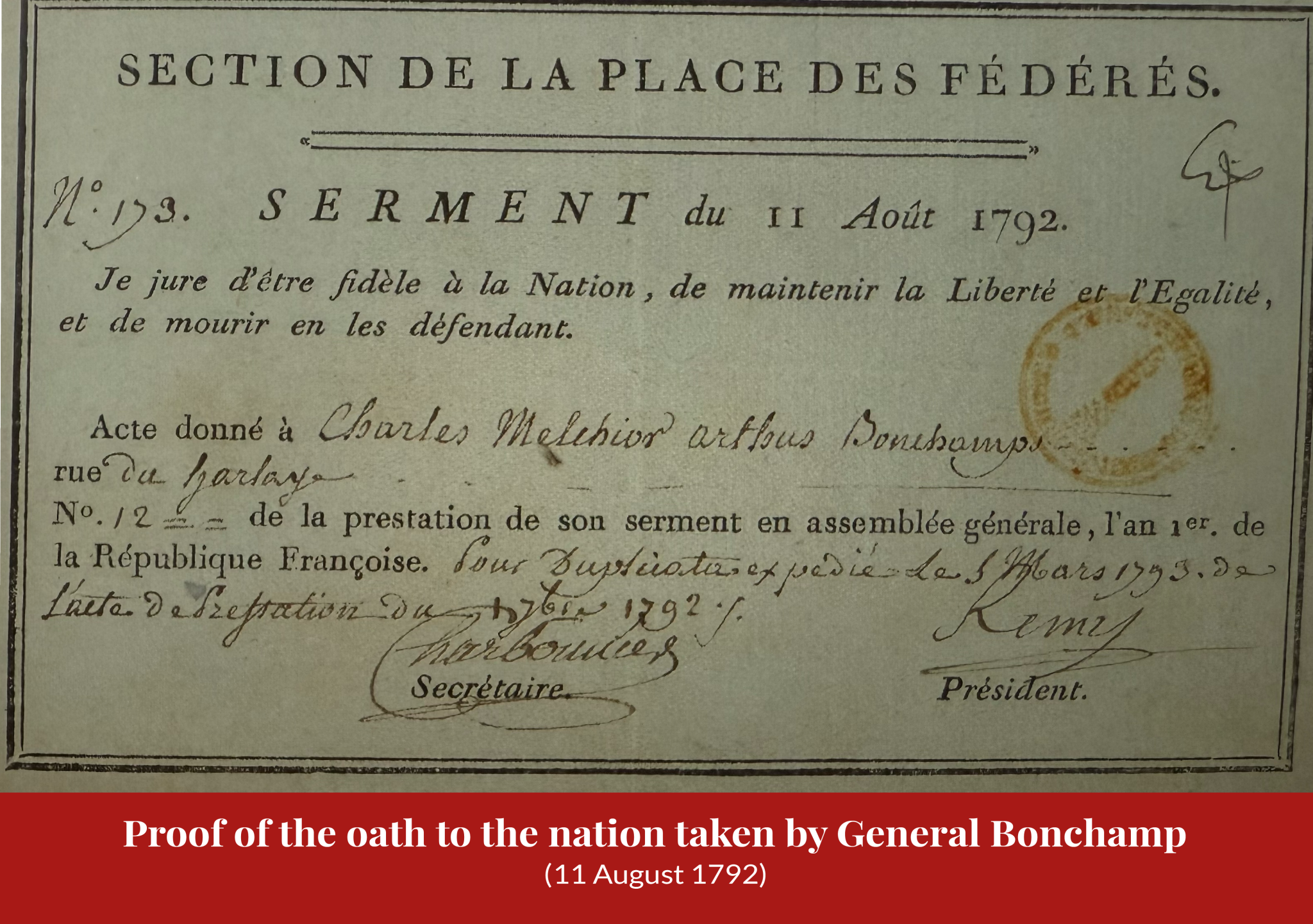
In 1789 he married Marie-Renée-Marguerite de Scépeaux, from another old Angevin family. The couple settled at La Baronnière, near La Chapelle-Saint-Florent, where they lived quietly through the first years of the Revolution. Bonchamps was not an émigré and did not participate in counter-revolutionary plots. In fact, he was one of many nobles who took the required oath of loyalty to the nation.
When the Vendée uprising broke out in March 1793, Bonchamps was drawn into it almost against his will. Peasants from Saint-Florent-le-Vieil came to ask him to lead them in revolt against the Republican levée en masse. Like many nobles drawn in the conflict, he hesitated, then accepted command of the local insurgents knowing that their chances of survival were, at best, limited. His military background quickly made him one of the most capable leaders of the Catholic and Royal Army of Anjou.
Bonchamps took part in the principal operations of that army: the capture of Bressuire, Thouars, Fontenay, and Saumur, and the failed assault on Nantes. Though he supported the royalist cause, he often opposed the excesses committed by some insurgents and tried to enforce discipline.
He was seriously wounded several times during the campaign. On 17 October 1793, at the Battle of Cholet, he received a mortal wound to his abdomen while leading his troops.
This is how his wife recounts the event in her memories (translation by me).
The death of Bonchamps
The Vendéan generals resolved to make a final attempt to save Cholet 1, a town of vital importance, for it was the key to the Vendée. M. de Bonchamps and his fellow commanders prepared accordingly for a general engagement. The Vendéan forces took position upon the heights of Saint-Christophe-du-Bois, resolved to perish rather than suffer the enemy to take the town.
M. de Bonchamps, whose foresight never failed him 2, understood that the outcome of this battle would decide the fate of the royalist army. He accordingly turned his thoughts to the possibility of retreat and gave counsel on this critical matter. Time would prove the prudence and sagacity of his advice, yet unfortunately it was not heeded. All the generals agreed to entrust him with the arrangement of the army’s order of battle, and his dispositions were universally admired.
At the given signal, the Vendéans charged with impetuous fury. The centre of the Republican army was broken through by M. de Bonchamps himself. The ferocious Carrier 3, present in the ranks, had a horse shot from under him. The two sides soon met in close combat, fighting hand to hand, and nothing could withstand the royalist advance. Their victory seemed assured.
The Vendéans had swept all before them and had already entered the outskirts of Cholet. Suddenly, however, the Convention’s grenadiers re-formed, and the troops of Mayence (Mainz) 4 pressed forward. The tide of battle turned. Flanked upon the great heath by Republican cavalry, the royalists were driven back. Their generals sought in vain to stem the rout. Even the voice of my husband went unheeded amidst the panic.
In a last desperate effort, the chiefs gathered what men they could, formed a squadron, and with a handful of Vendéan horsemen hurled themselves, like men possessed, into the midst of the enemy lines. It was in that fatal moment that M. de Bonchamps received a mortal wound to the lower abdomen. He fell, covered in blood.
M. Piron 5 managed to cut through the enemy and carry him off, sparing him at least the horror of falling alive into enemy hands. The Republicans were executing prisoners indiscriminately. A stretcher was procured. At this sight, the Vendéans rallied, determined to escort and protect their wounded general. They surrounded him, taking turns to bear the stretcher for five long leagues, all the while pursued by the enemy.
He was conveyed to Saint-Florent 6, where five thousand Republican prisoners were being held within the church. Until then, religion had preserved the Vendéans from the crime of bloody reprisals 7. As I have already said, they had treated their enemies with honour and generosity. But when the report spread that my unfortunate husband had been mortally wounded, their fury equalled their despair. They swore to put the prisoners to death.
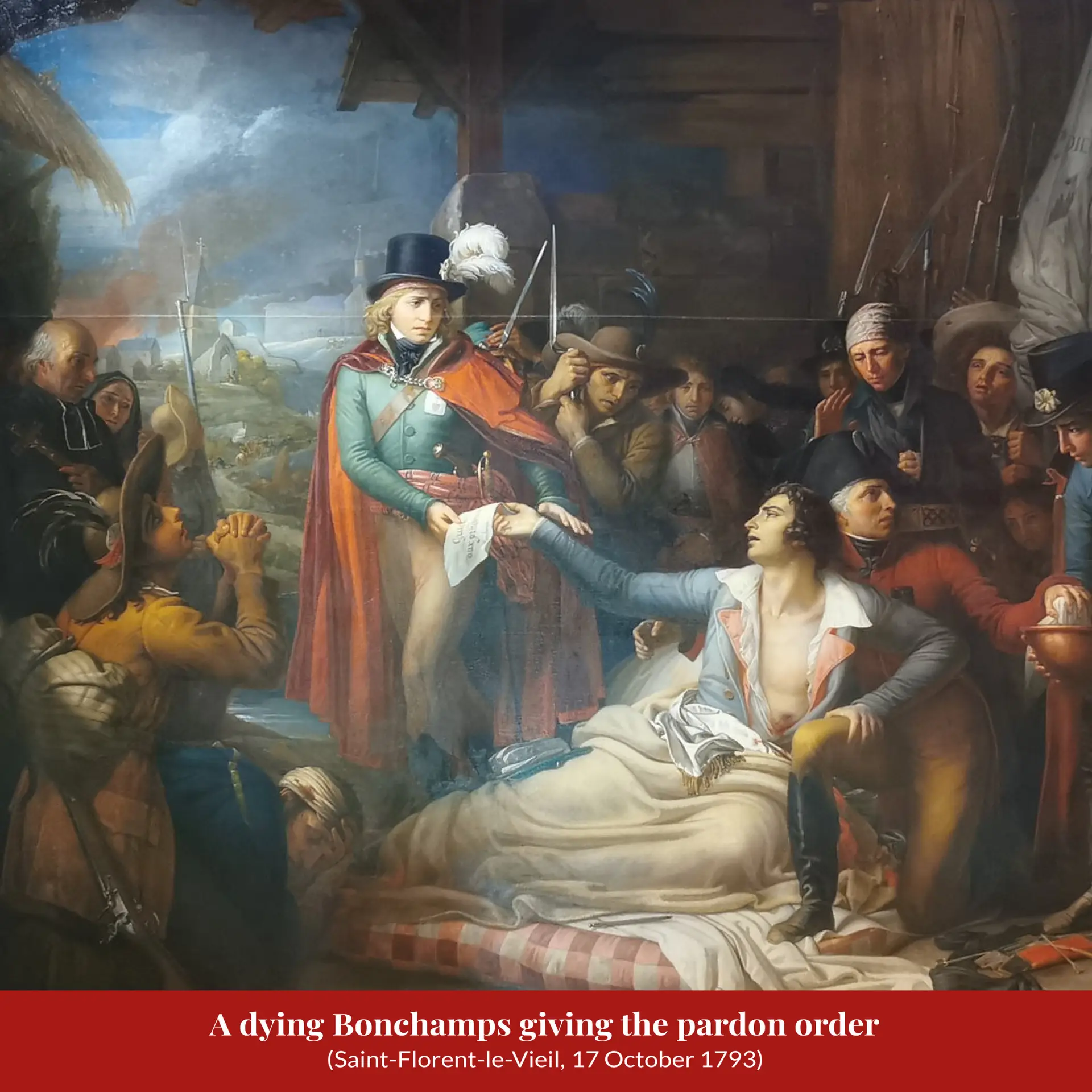
At that moment, M. de Bonchamps was taken to the house of Madame Duval in the lower part of the town. The officers of his army gathered, knelt around the mattress upon which he lay, and awaited with cruel anxiety the surgeon’s verdict. But the wound was grave beyond hope. M. de Bonchamps read it in the sombre expression on every face. He sought to calm the sorrow of his officers and insisted that his final orders be obeyed.
He commanded that the prisoners held in the abbey be spared. Then, turning to M. d’Autichamp 8, one of the officers he held most dear, he added:
“My friend, this shall surely be the last order I give you. Let me die knowing it will be carried out.”
That dying command had the effect one might expect of a man so deeply revered. Scarcely had it been made known than cries arose from every part of the camp: “Mercy! Mercy! Bonchamps commands it!” And so the prisoners were saved.
A brief improvement in his condition raised some faint hope, and my husband wished to be moved from Saint-Florent. He had himself carried to the village of La Meilleraie 9, to the house of a fisherman. There, feeling death approach, he turned wholly to his religious duties. In his final hours he was attended by two venerable priests, Messieurs Courgeon and Martin. He received their exhortations not only with courage, but with joy. They promised him the eternal rewards reserved for a life of purity, the fulfilment of duty, and the keeping of one’s oath.
After hearing them, M. de Bonchamps lifted his eyes and hands to Heaven, and said, in a voice still firm:
“Yes, I dare to trust in the mercy of the Most High. I did not act from pride, nor to secure a name that perishes with time. I did not fight for human glory. I sought to overthrow the bloody tyranny of impiety and crime. If I have failed to raise again the altar and the throne, I have at least defended them. I have served God, my King, and my country. I have learned to forgive.”
All who were present were moved to tears. His faith and his quiet fervour seemed to pass from his soul into theirs. M. de Bonchamps repeated more than once that he had been promised the prisoners would be spared, and that he counted upon it. And after receiving the last rites with angelic piety, he gave up his soul in the arms of Messieurs Courgeon and Martin.
The tears of every brave man were the funeral oration of M. de Bonchamps. Even his enemies paid just tribute to his memory.
(Mémoires de Madame la Marquise de Bonchamps, sur la Vendée, 1823)
A tomb worthy of a hero
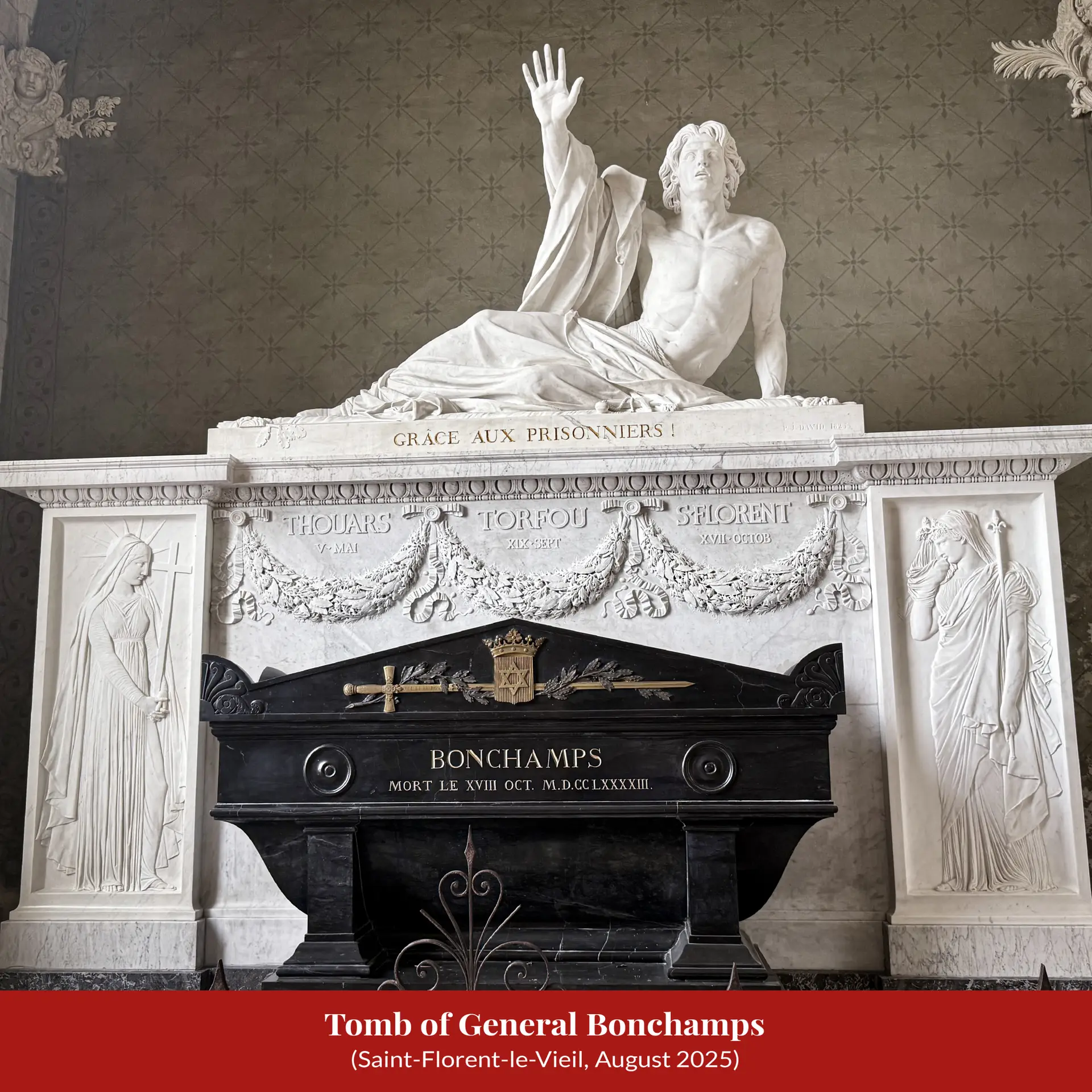
Charles de Bonchamps was first buried in Varades, near the place where he died. Twenty years later, however, his family decided to bring him home to Saint-Florent-le-Vieil.
It was 1824, nine years after Napoleon’s fall, with a Bourbon securely back on the throne. France was weary of division, and the new regime was eager to cultivate a spirit of reconciliation. The king 10 himself had little interest in reopening the wounds of the Vendée, yet the mood of the time allowed certain figures from the war to be honoured as national heroes 11. Among them, Bonchamps was the least controversial: a moderate, politically centrist, his legacy untainted by fanaticism. When his family launched a public subscription to finance a monument to him, no one objected.
The chosen sculptor, however, was an unexpected one. Pierre-Jean David, later known as David d’Angers, was a committed republican. His selection had nothing to do with politics and everything to do with talent, and with a curious link between sculptor and subject.
Among the five thousand Republican prisoners spared by Bonchamps on his deathbed was a carpenter and wood sculptor named Pierre Louis David. He was not a particularly important man, but he had a son who would become one of France’s foremost sculptors. That son was David d’Angers.
It was he who created the extraordinary monument that now stands in the church at Saint-Florent-le-Vieil. It shows Bonchamps dying, half-reclining on a stretcher, bare to the waist, his right arm lifted in command. The pose, with the arm extended and hand open, comes from classical models. David had studied the figure of the river-god Ilissos from the Parthenon’s west pediment while in London in 1815, and the clean lines of the body show that influence. But in Bonchamps he moved away from the calm of Classicism, giving the figure a human urgency closer to early Romanticism. The general’s head is thrown back, his mouth slightly open, his face tight with pain, his hair falling in loose curls, reminiscent of Alexander the Great.
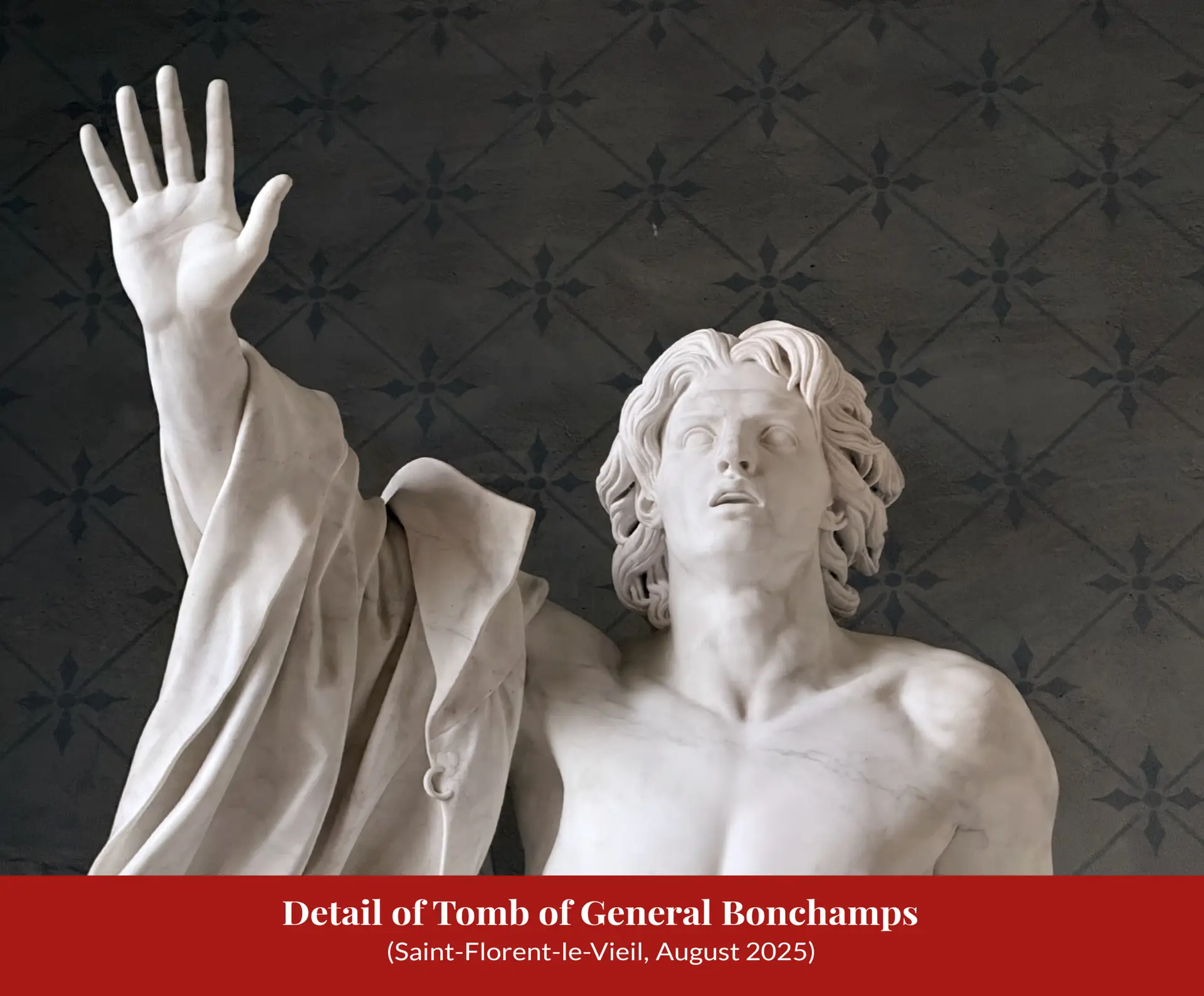
It is a striking work. When I saw it, I stood there for twenty minutes. If he were not carved in marble, I could almost imagine him crying out for mercy, trying to rise, to pardon the prisoners himself.
The genius of David d’Angers lies not just in the classical precision of the form, but in its expression of something far more difficult: the brutal truth of pain. The polished marble doesn’t hide the agony of the man, or the chaos of the moment it captures. It’s an agony that bridges across politics, across sides. Because life is sacred. Because it’s worth protecting. Because even in defeat, even in rage, we should err on the side of mercy. The Royalist general can pardon the Republican. The Republican can carve the tomb of the Royalist general.I will not wax pseudo-philosophical or poetic, but surely there is a lesson to be drawn there.
Footnotes
- 1Cholet was the principal town of the Vendée region and a strategic crossroads. Its loss would have opened the interior to Republican forces. The Battle of Cholet, fought on 17 October 1793, was a turning point in the war and marked the beginning of the Vendéan army’s retreat across the Loire.
- 2Bonchamps was a former officer in the royal army, a professional soldier known for his prudence and moderation. He was arguably the best strategist in the Vendéan army.
- 3Jean-Baptiste Carrier (1756–1794) was the Representative on Mission sent by the Convention to Nantes. I am fairly sure she is mistaken and that he was not present at Cholet.
- 4The armée de Mayence was a veteran corps paroled after the capitulation of Mainz in July 1793 and redeployed in the Vendée under Kléber. Hardened by siege service, the Mayençais had exceptional cohesion and dependable officers. They were later disbanded after being defeated by La Rochejaquelein at Entrammes.
- 5Dominique-Louis Piron (1760–1794) was a veteran of the American War of Independence and later an officer in the merchant navy. He eventually settled near Nantes, where he became captain of the National Guard. Soon viewed with suspicion, he emigrated for a time before returning to France and establishing himself at La Varenne, in the Mauges, near the Loire. When the uprising began, he joined Bonchamps’s army and distinguished himself in several victories at Vihiers, Coron, and Pont-Barré. He later took part in the disastrous Virée de Galerne and was killed while attempting to recross the Loire.
- 6Saint-Florent-le-Vieil, situated on the Loire, was a key town at several points in the Vendéan War. It was where the uprising began and where most of the army crossed the Loire river during its flight towards Brittany.
- 7Pardons were not uncommon in the Vendéan army. On the contrary, it was rarer for the generals to tolerate excessive cruelty. What makes Bonchamps’s gesture exceptional is that he was dying, that it came after a devastating defeat which had inflamed the army’s anger, and that it concerned such a large number of prisoners.
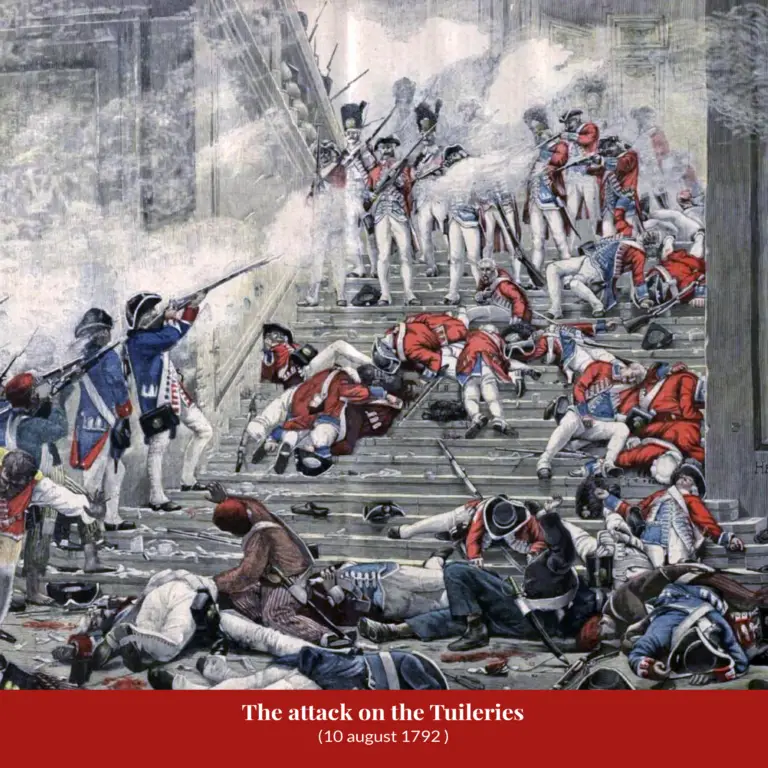
- 8Charles-Marie de Beaumont, Count of Autichamp, was one of the few senior leaders of the 1793 uprising to survive. An Angevin nobleman, d’Autichamp began his career in the regiment of Condé before the Revolution. He emigrated for a time but later returned to France and joined the Constitutional Guard of Louis XVI, taking part in the defence of the Tuileries on 10 August 1792 alongside Henri de La Rochejaquelein. When unrest broke out in the Vendée, he joined his neighbour and cousin General Bonchamps, becoming his chief lieutenant. After the defeat at Cholet, he took part in the Virée de Galerne as far as Granville, narrowly escaping death at Le Mans. He remained in arms until his surrender to General Hoche in 1797.
- 9La Meilleraie was a village now absorbed into Varades. The house where Bonchamps died is still standing and open to the public. It is often used as an exhibition space.
- 10Either Louis XVIII or Charles X, depending on the period of the Restoration in question.
- 11This is why we have nine large heroic paintings of the Vendéan leaders (except Stofflet, for reasons). They were commissioned by the king. There is a separate post on this blog with more detail on that subject called The Portraits of Vendeen Generals
Sources & further reading
- Marie-Renée-Marguerite de Scépeaux, marquise de Bonchamps, Mémoires de Madame la marquise de Bonchamps (Paris: Baudouin frères, 1823)