



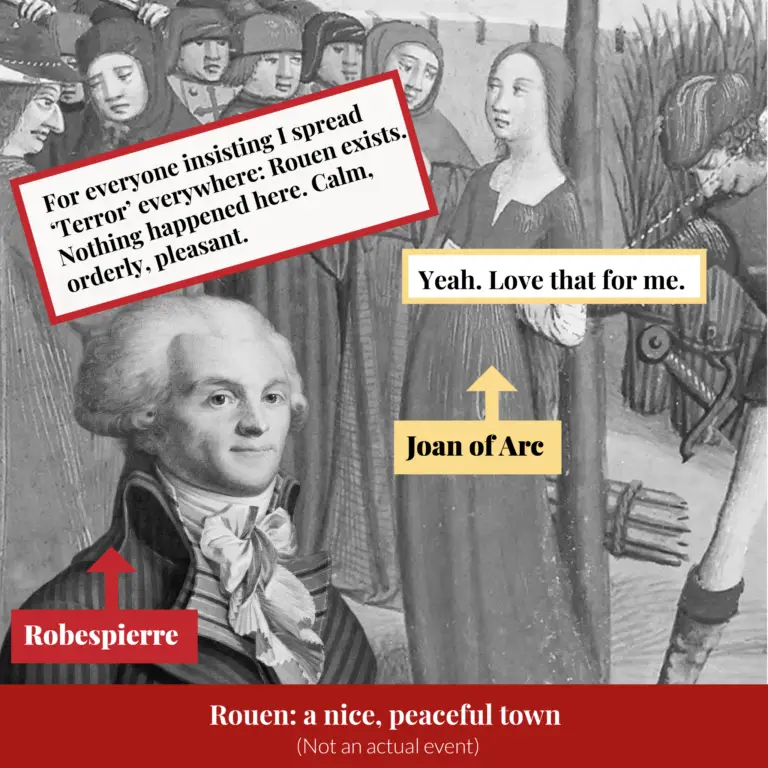


Before entering the Vendée, which enjoys the dubious distinction of having the most executions during the Terror, we stopped in a city at the opposite extreme: Rouen. In Year II (1793–1794) it saw exactly zero executions 1.
The Most Boring Revolution
Rouen entered the Revolution as a major textile centre and port, whose importance was already sliding downhill. Its cottons and linens have earned it the title “Manchester of France,” but, realistically, by that point, England was outpacing it, and Le Havre had taken over transatlantic trade.
Its revolutionary story is remarkable in how unremarkable it is. In 1789 there were food riots and factory sackings, but order returned quickly under a municipal council. It became chef-lieu 2 of the new Seine-Inférieure department, governed by the same moderate commercial elite as before. The Civil Constitution of the Clergy 3 split opinion but caused little unrest.
War broke out in April 1792. Blockade and inflation hit hard, so authorities enforced the Law of the General Maximum on goods and wages. Merchants and artisans were not amused, but did little in retaliation. The effect of the revolutionary government in Rouen was felt chiefly through price control measures Grain, flour, and firewood were sold at regulated prices, and officials prosecuted hoarders.
Food riots did break out occasionally.For example, May 1793 saw crowds seize grain, with National Guards called to restore calm. That being, said Rouen never descended into Paris-style lynchings.
In 1793–1794 Rouen applied the Law of Suspects, secularised churches and closed convents, even turning the cathedral into a Temple of Reason, but it neither rebelled nor empowered ultra-radicals; suspects were mostly imprisoned or sent elsewhere for trial, and no guillotine operated in the city.
While these controls temporarily eased shortages, they also caused black markets and did not prevent acute scarcity in 1794–95, when harvest failure and assignat inflation produced famine conditions. The winter of 1794–95 was especially grim: bread rationing was instituted, and soup kitchens tried to feed thousands of destitute Rouennais.
Rouen’s restraint came from cautious local leadership, a public more interested in bread than ideology, the absence of a federalist revolt, and political clubs more concerned with order than zeal. After Thermidor, prisoners were released without much fuss. The city came out of it intact, if somewhat bureaucratically restructured.
The pattern was often that popular protests erupted over high prices or hunger, and the municipal government responded with negotiation and policing.
If your image of the Revolution involves daily executions, mobs with pikes and hanging aristocrats from lap posts , Rouen will disappoint. Life here during the early Republic was, relatively speaking, uneventful.
Which is why I didn’t expect to find much Revolutionary heritage on arrival. And I didn’t.
And yet, for a city with no Terror executions, Rouen’s modern tourist identity is built almost entirely on one execution: that of Joan of Arc (1431).
Joan of Arc
Walk the streets of old Rouen and you quickly notice that its tourist office decided the main claim to fame is burning a teenage girl at the stake and dumping her ashes in the Seine.
I’m no medievalist, but if Joan isn’t familiar, here’s the short version to spare you a search. Joan of Arc (c.1412–1431) was a peasant girl from Domrémy in Lorraine who claimed divine visions told her to back Charles VII and help drive out the English during the tail end of the Hundred Years’ War. In 1429, aged seventeen, she convinced Charles to let her join his army. Her arrival changed morale: she helped lift the siege of Orléans and got Charles crowned at Reims. That was her high point.
Things went downhill after that. She was captured in 1430, sold to the English, and put on trial in Rouen, then under English control. The tribunal, led by Bishop Pierre Cauchon, accused her of heresy, witchcraft, and cross-dressing (because heaven forbid a woman wear trousers during wartime… fetch the smelling salts).
She was convicted and sentenced to death. On 30 May 1431, she was burned at the stake in the Vieux-Marché (Old Market). Witnesses say she prayed until the end, calling on Jesus as the flames rose. Her ashes were tossed in the Seine to stop anyone collecting relics.
The Church of Joan of Arc
The old market in Rouen is gorgeous. Half-timbered Norman houses, cobbled streets, the works. And then right in the middle of it: the most aggressively 1970s building imaginable. That’s the Church of Joan of Arc.
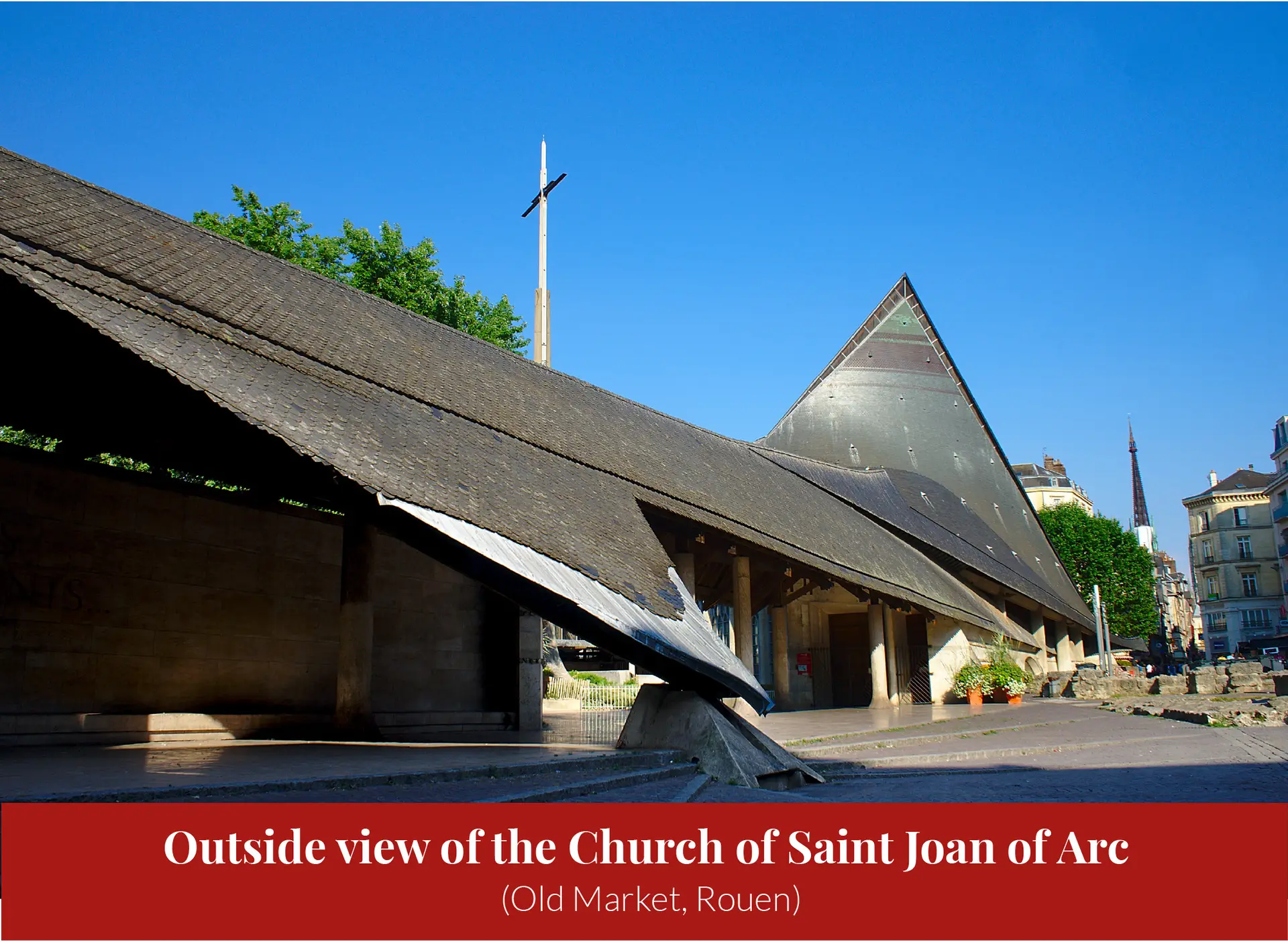
The idea, apparently, was to evoke an overturned longship (as some early churches did) and flames. Let’s just say we’re lucky she was burned. If Joan had been hanged or beheaded, I shudder to think what the architect might have produced.
Inside, the stained glass is the real surprise. It’s 16th-century glass salvaged from the Church of Saint Vincent, destroyed in the Second World War. The windows are luminous, delicate, and very beautiful, which is more than can be said for the rest of the building.
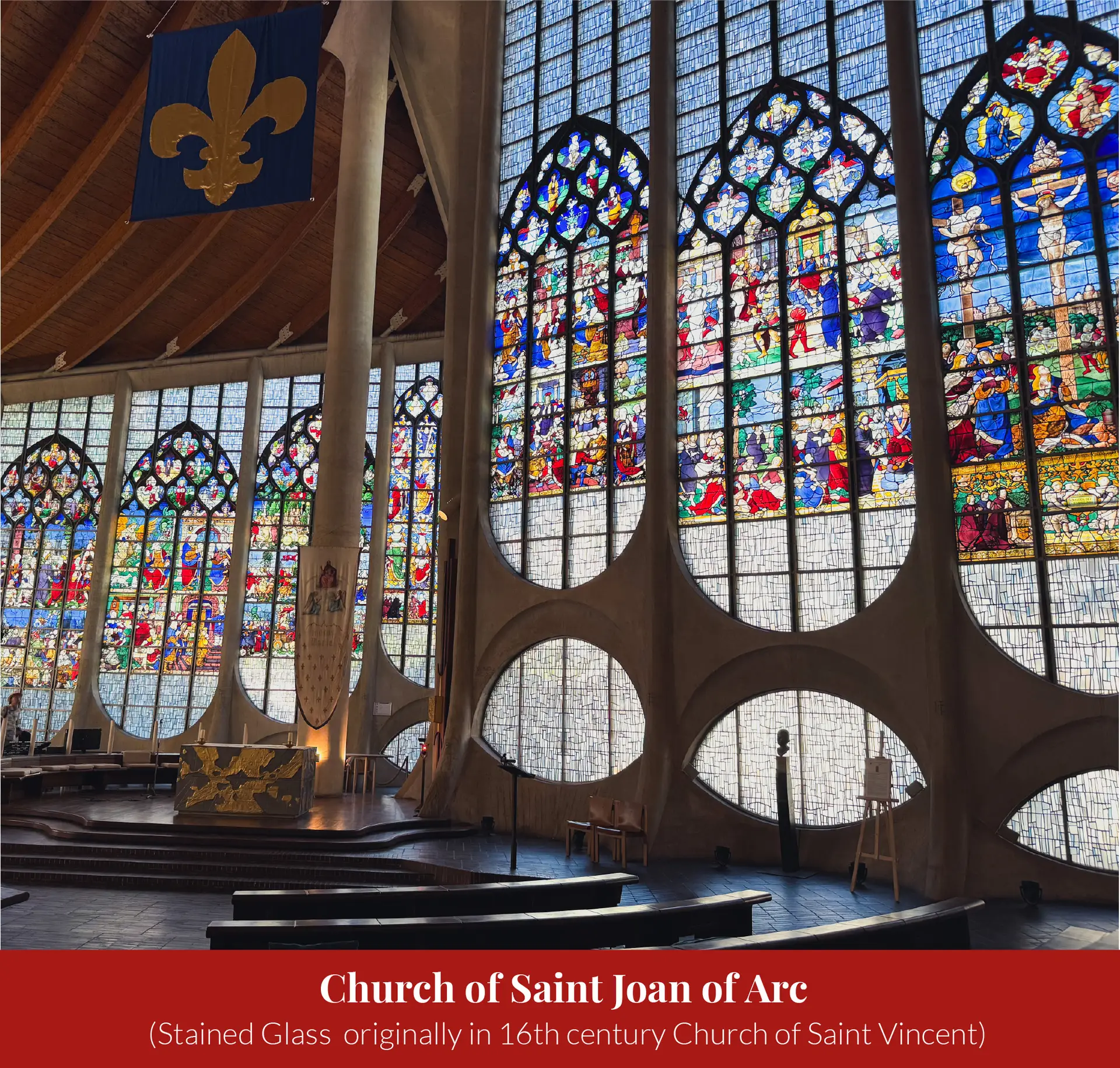
I’ve never seen a Catholic church like it. I’m not religious, so I’ve no opinion rooted in dogma, but it feels more like a minimalist art gallery than a place of whorsip. Which might suit some people fine. I just wonder if anyone finds it comforting to pray here.
There are artworks inside, all focused on Joan’s martyrdom. They’re beautiful, but again, the overall effect is more museum than church.
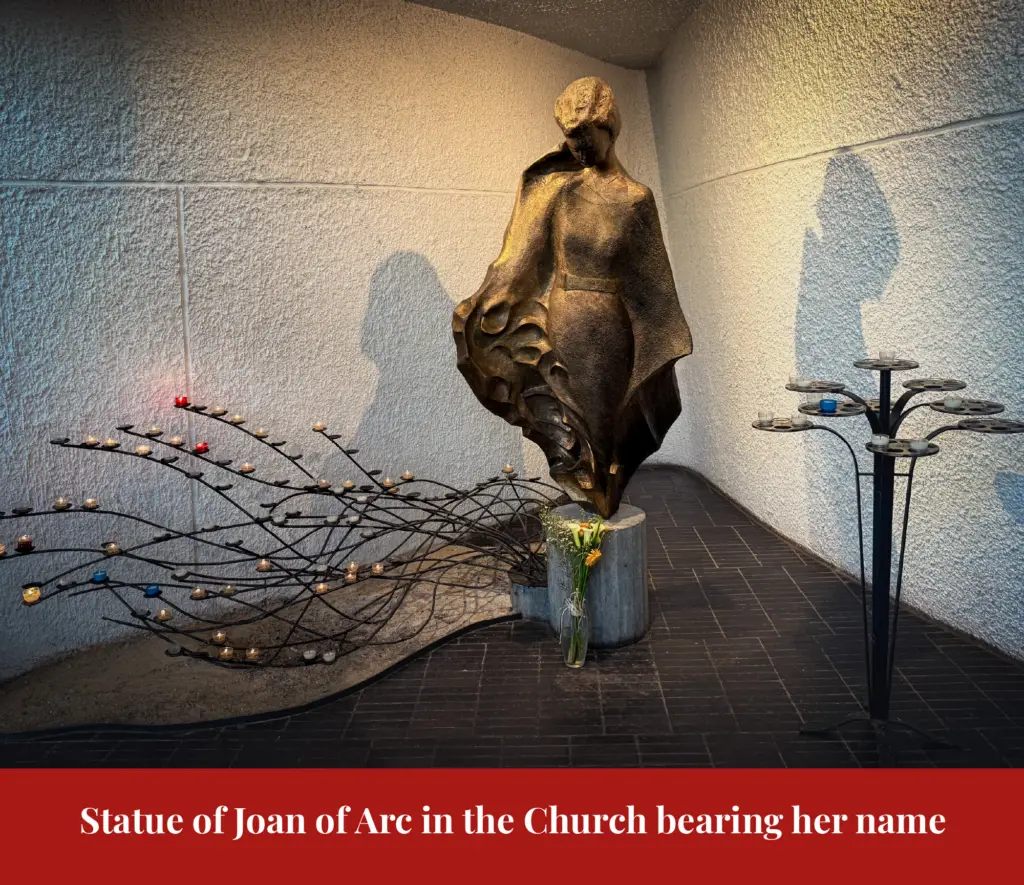
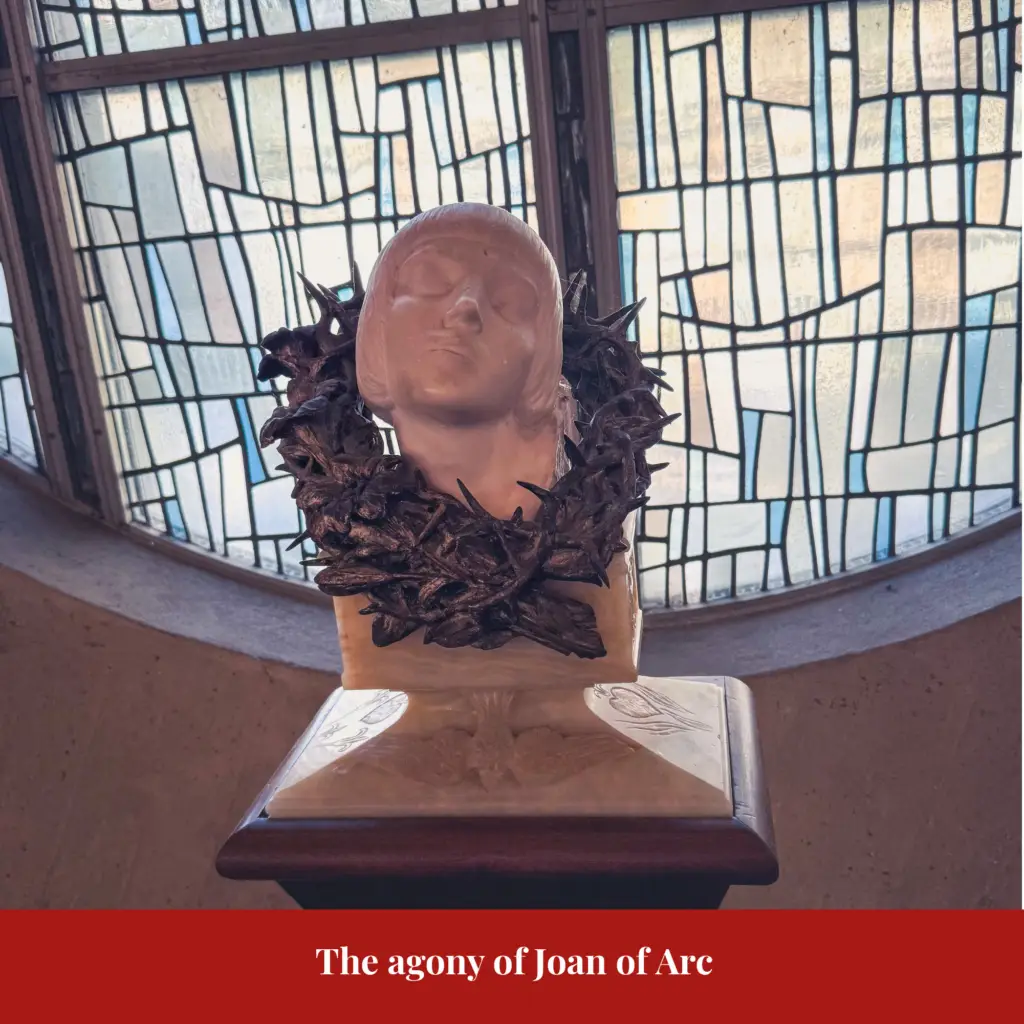
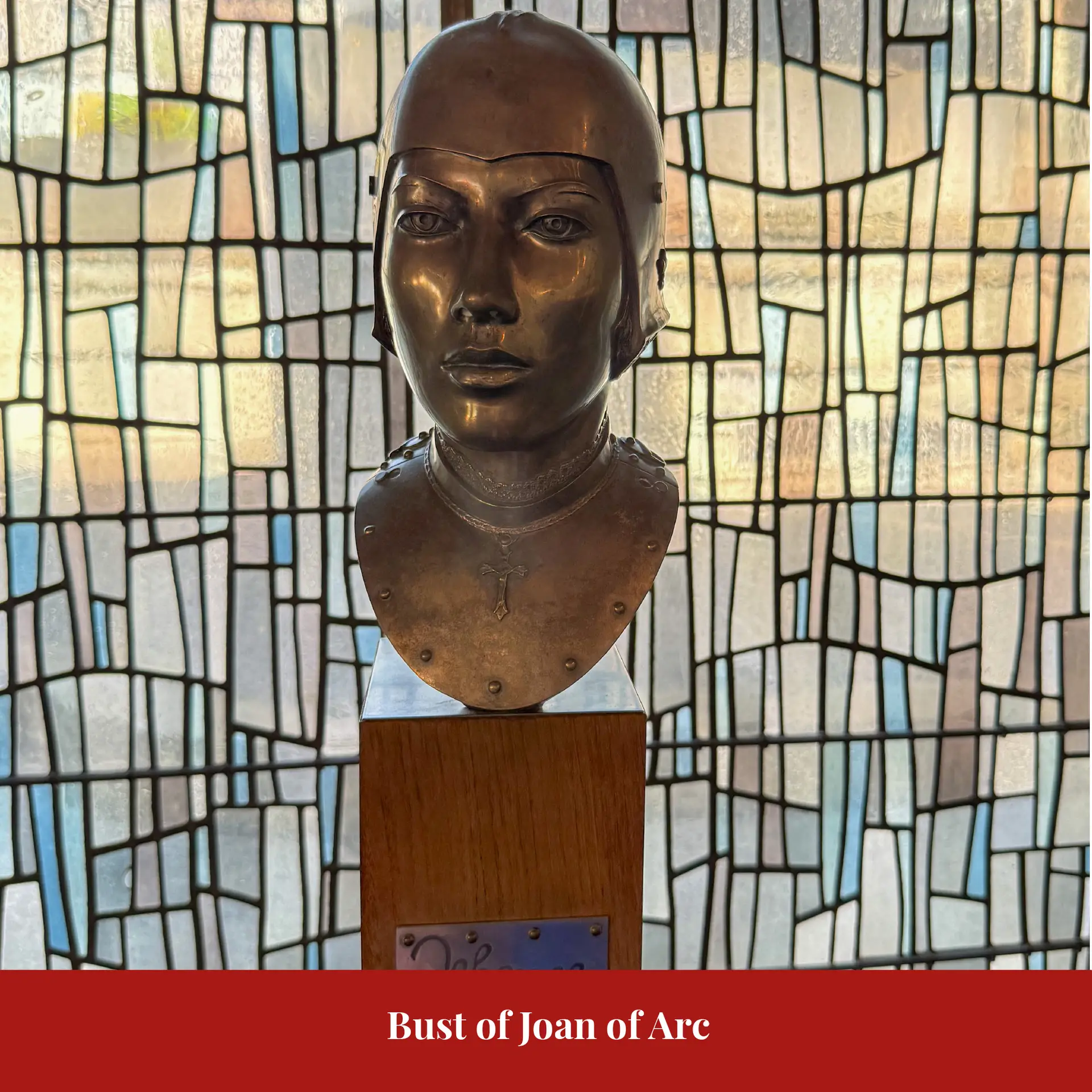
Step outside and you’ll find a metal sculpture meant to mark the site of the stake. I forgot to take a photo. It was dull and the children wanted to go on the carousel.
The Food Break
There’s an understanding in this household : I drag us to obscure Vendée-related locations, and my husband gets his reward in food.
In Rouen, I gave in to the obvious and booked us into La Couronne, France’s oldest inn, dating from 1345, conveniently located opposite the church. I couldn’t resist.
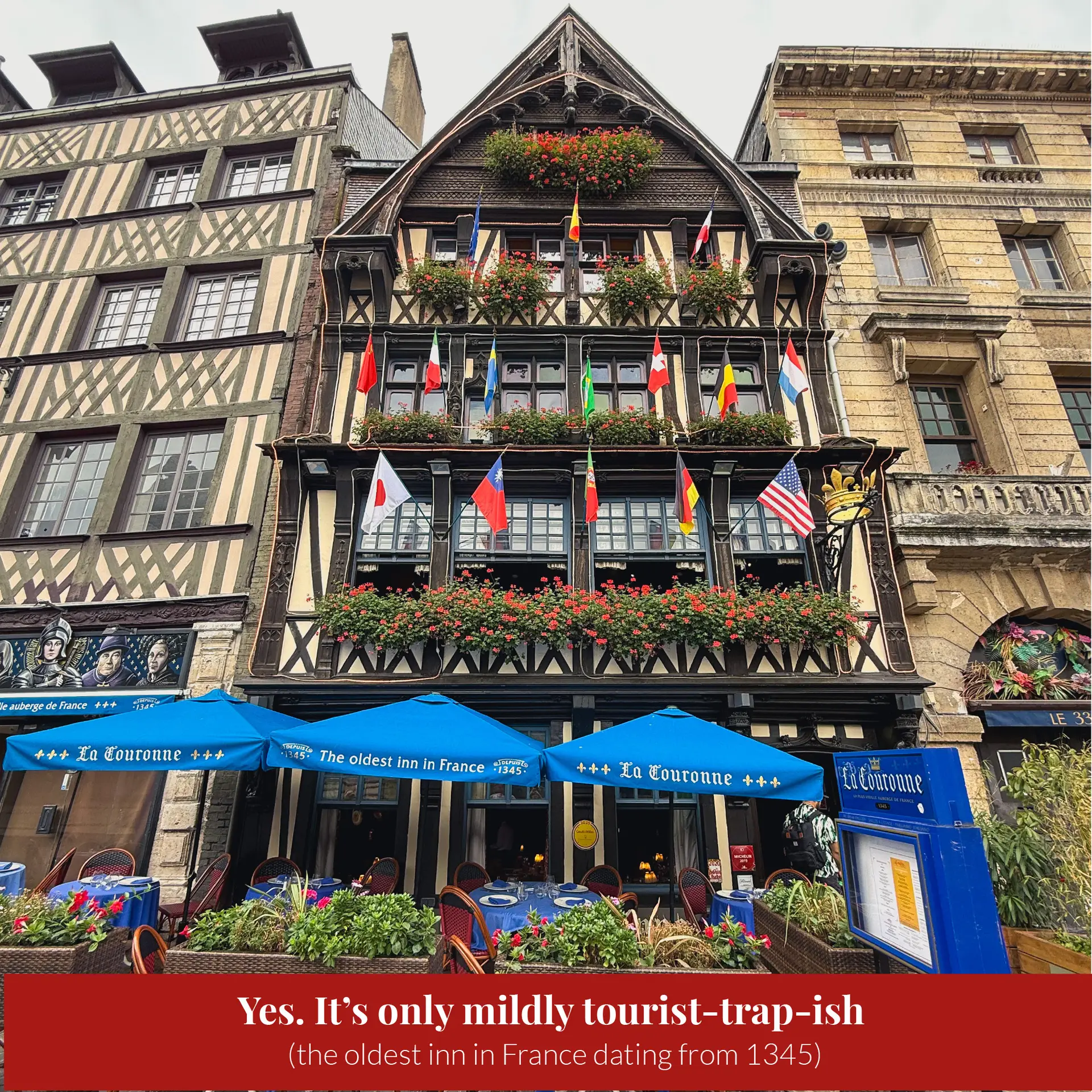
The interior is beautiful. Genuinely.
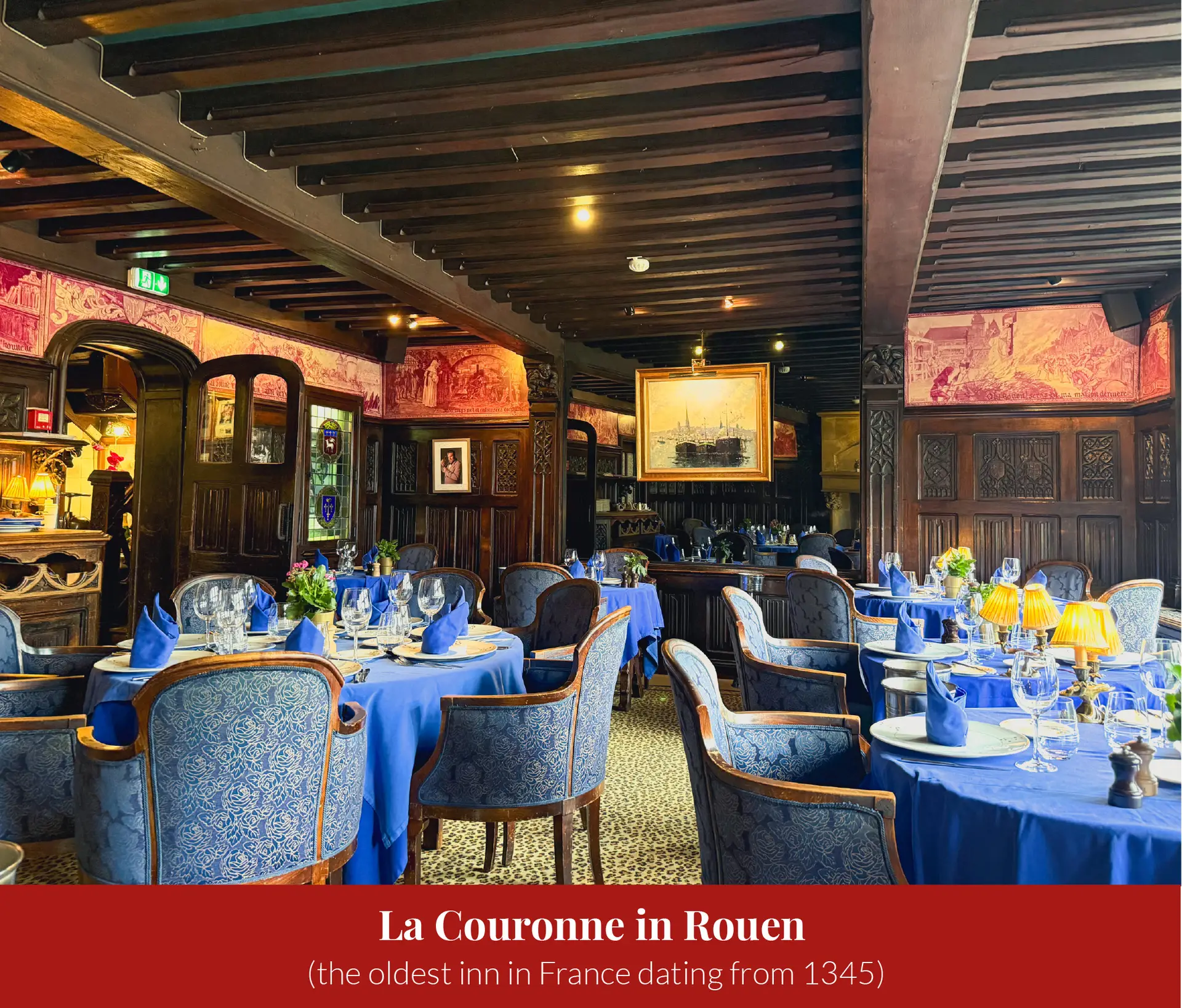
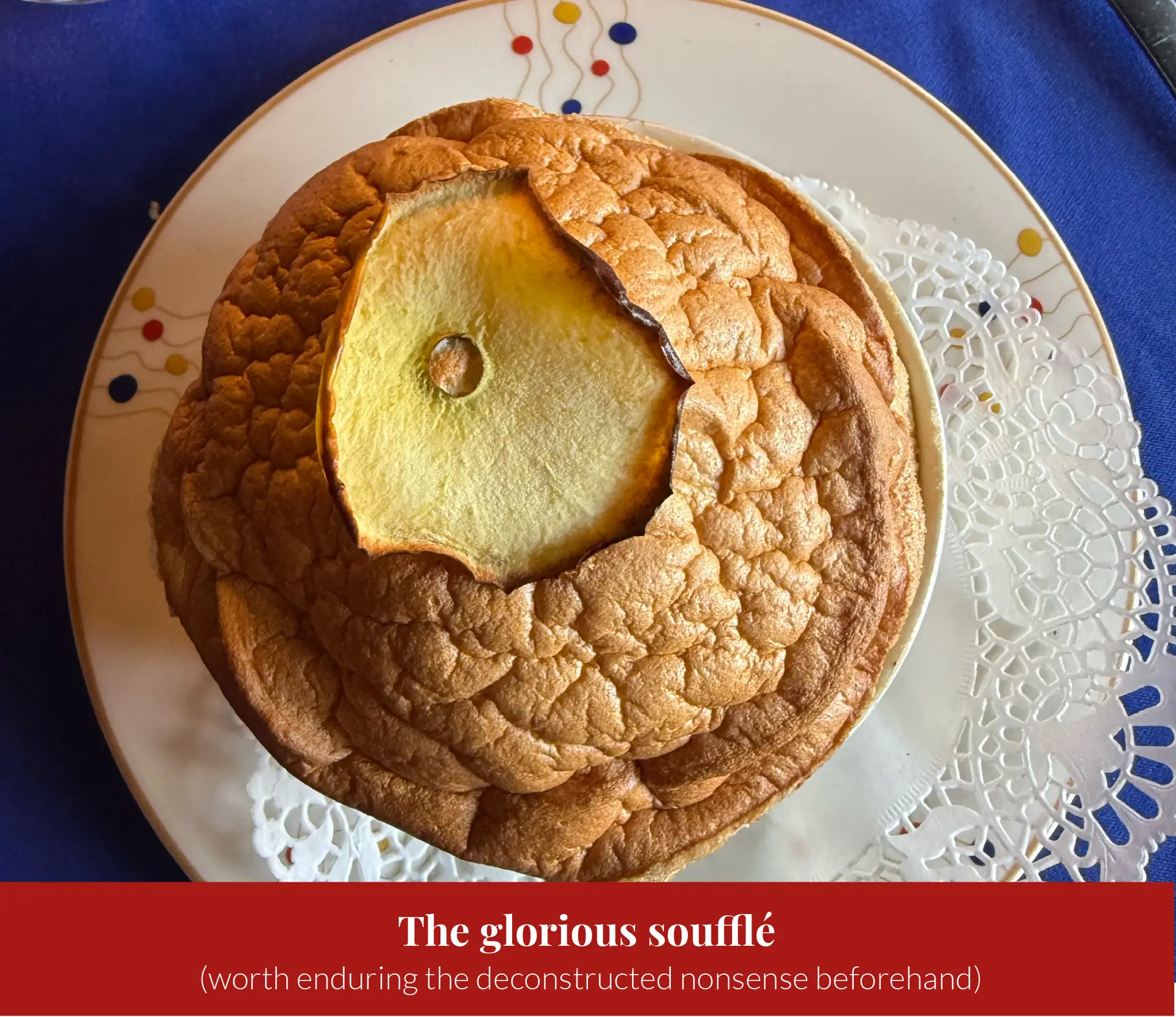
This isn’t a food blog, so I’ll be brief. They really ought to stop trying so hard. If you’re the oldest inn in France, maybe stick to the basics and leave the deconstructed sushi alone. Still, the Norman soufflé with cider at the bottom was excellent. Not much to look at, but genuinely tasty.
That’s Rouen done. Next stop: Normandy, where things begin to go downhill for the Catholic and Royal army.
Footnotes
- 1Yes, really. Some places didn’t go through mass executions. The “Terror” was neither as widespread nor as industrial as later legend would suggest. I’m working on something that gets into the details.
- 2Chef de lieu was the capital of a department.
- 3The Constitution of the Clergy was a 1790 law that tried to nationalise the Catholic Church in France. It went about as well as you’d expect.