





One of the lovely people on Tumblr asked me quite a while ago whether Saint-Just really lied about his age in order to stand for election. I’m rather glad they did, because it turns out to be one of those small episodes that is not only interesting in itself, but also gives us an excuse to look at some of the rules governing elections during the French Revolution. And I love writing about rules.
The short answer is yes, as far as I can tell, it is true, and it was not a single incident. Saint-Just seems to have tried variations of the same trick several times between 1790 and 1791.
I have not personally gone through all of the surviving primary documentation for these episodes, so there may be details I am missing. However, both Bernard Vinot and Antoine Boulant discuss them in their biographies of Saint-Just, and the broad outline is fairly clear.
First, though, why did he need to lie about his age at all?
Under the laws of the early Revolution, a man had to be twenty-five to qualify as an “active citizen”, which meant the right to vote in certain elections and to stand for office. Saint-Just was ambitious, wanted to leave his provincial life and take part in politics, and probably thought the rule was idiotic. Which, to be fair, it was. So he lied about his age and obscured it when challenged.
One of the earlier episodes came in May 1790, when he acted as a delegate for his canton at the assembly in Chauny that was deciding whether Soissons or Laon would become the chef-lieu (capital) of the Aisne department.
Then, in October 1790, during the election of a justice of the peace in his home canton of Blérancourt, the question of his age seems to have become public. Saint-Just was trying to control the primary assembly so that one of his allies would be elected, and his supporters even had him chosen as president of the assembly. At that point Gabriel Liret publicly denounced him for not being old enough to qualify as an active citizen. Saint-Just’s response was actually quite clever. He resigned gracefully, vaguely mentioning his “youth” and his love of order and the law, but also insisted that the minutes record that his accuser had not actually stated his precise age. In other words, he admitted to nothing.
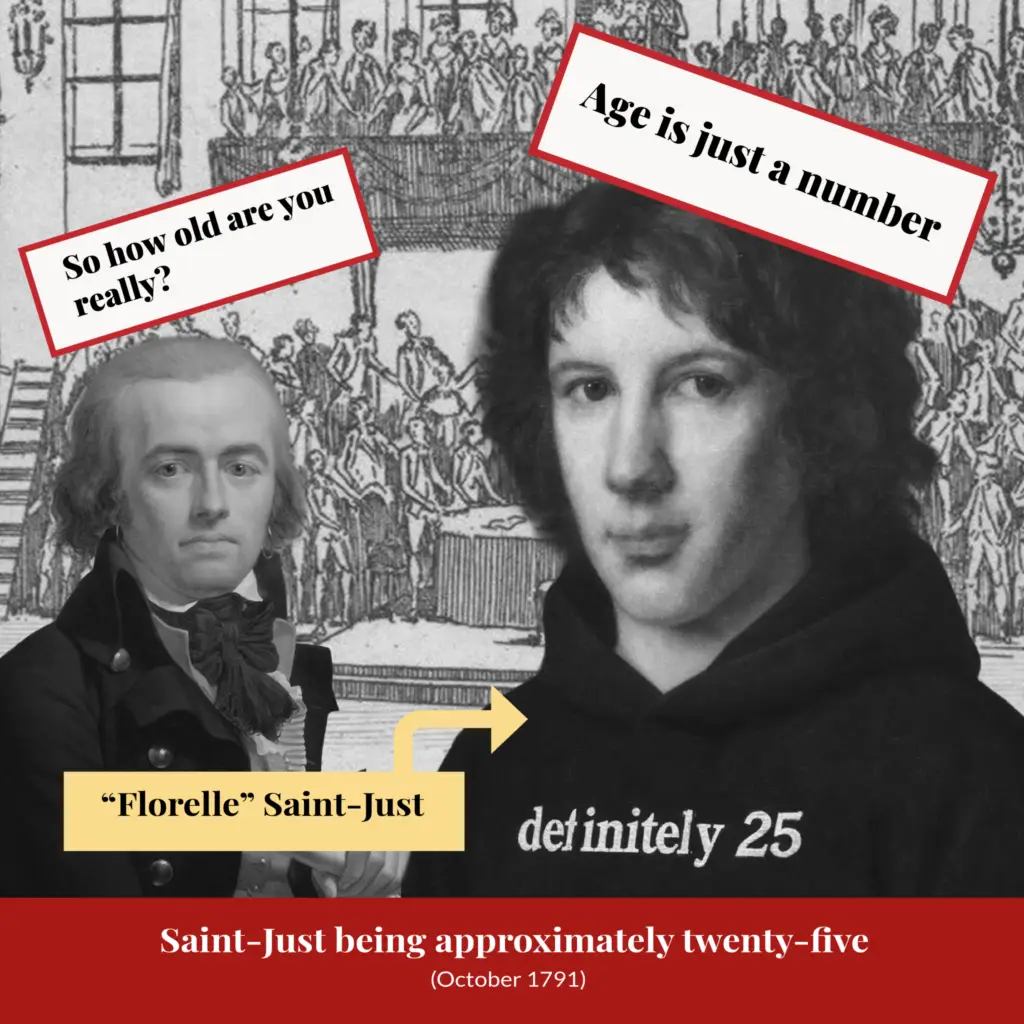
In this context, as a delegate for the Blérancourt canton at an electoral assembly held in the church of Saint-Martin at Chauny, he gave a speech in favour of Soissons becoming the departmental capital. His rival Antoine Gellé objected that he was under the legal age of twenty-five. Saint-Just still managed to have the text of his speech entered into the official minutes, but he signed it “Florelle de Saint-Just”. The point seems to have been to muddy the waters. If anyone decided to investigate his age properly, they would be looking for the baptismal or birth record of a man named Florelle, which would obviously get them nowhere.
The major episode, however, that people are usually referring to was the election to the Legislative Assembly in 1791.
Under the system at the time, active citizens met in primary assemblies to choose electors, and those electors then went on to the departmental assembly to elect the national deputies. Saint-Just wanted to become a deputy to the new Legislative Assembly. In June 1791 he managed, despite being underage, to get himself elected as an elector with the support of his local supporters. His rivals, however, were not amused. Antoine Gellé, together with his lot, denounced his age again and demanded his removal. This time Saint-Just didn’t manage to get out of it. The procureur-syndic of the district of Chauny opened an investigation and obtained definitive proof of Saint-Just’s real date of birth.
The final blow came at the departmental electoral assembly in Laon in September 1791. The question of his age was raised formally, the assembly demanded proof, and Saint-Just could not legally justify his eligibility. On 7 September 1791, the president of the assembly, Jean Debry, struck him from the list of electors. A few days later, Antoine Gellé produced the documents supporting the invalidation and took his place.
In the end, with a bit of luck for him, the problem solved itself. The fall of the monarchy on 10 August 1792 led to new elections for the National Convention under universal male suffrage, and by a rather convenient stroke of timing, Saint-Just turned twenty-five on 25 August 1792, literally a day before the primary assemblies met on 26 August.
Sources & further reading
- Boulant, Antoine. Saint-Just: L’archange de la Révolution. Paris: Passés Composés, 2020.
- Vinot, Bernard. Saint-Just. Paris: Fayard, 1985.