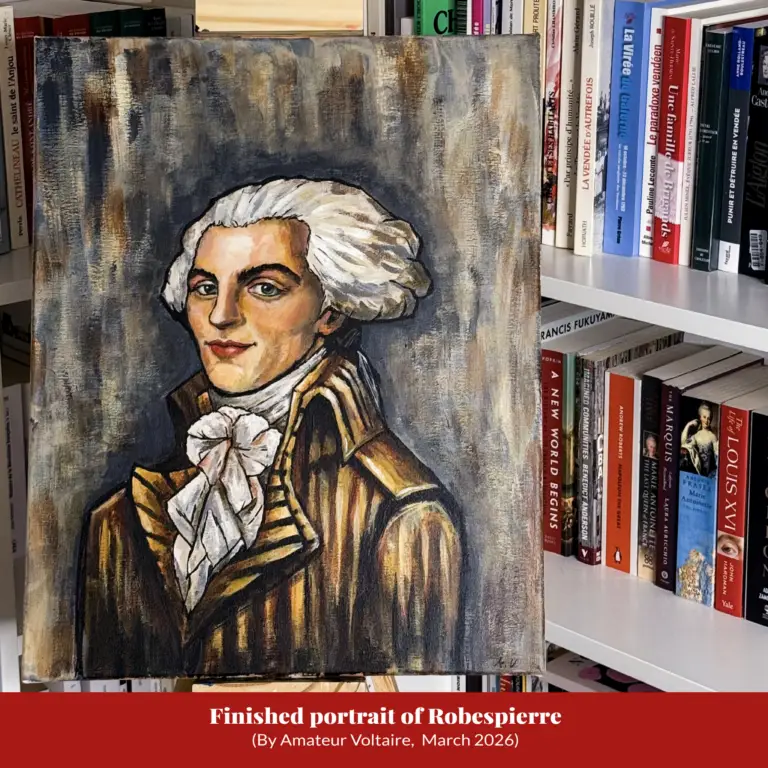

My portrait of Robespierre is finished now, varnished and waiting for me to work out how to frame him. He turned out way better than I expected, and I am genuinely pleased with how he looks. No really. I can’t stop looking at him.
Anyway, that is enough self-congratulation. This is not an art blog (at least not reliably, though I have been dabbling… as usual, I struggle to have one hobby at a time). This is a history blog, so I will turn the painting into a question: what did Robespierre actually look like? And, more importantly, how do we know how he looked like?
What did Robespierre look like?
Modern biographers tend to agree that Maximilien Robespierre was not a physically imposing man.
He was slight, thin, and of average or slightly below-average height. His complexion was pale, lightly marked by smallpox. His eyes were green. His eyesight was poor; he wore spectacles often, at times even two pairs to see at a distance.
Some portraits show these pushed up on his forehead. He also used tinted lenses, blue or green, to protect his eyes (as someone whose eyes water uncontrollably in any sort of sunlight, I can only empathise).
Observers frequently mentioned an involuntary nervous tic affecting his eyes and occasionally his mouth, along with a habit of constant blinking and an avoidance of direct eye contact. His voice, somewhat inconveniently for someone who spoke for a living, was not especially strong and did not carry well.
For someone cast as a champion of the people, his personal appearance was careful and precise, and firmly rooted in the fashions of the Ancien Régime 1.
He avoided the fashions of the revolution, namely the sans-culotte 2 dress entirely, with no trousers, no carmagnole, no red cap 3. Instead, he remained powdered, neatly styled, and well dressed. He favoured culottes, white stockings, buckled shoes, and a sharply arranged white cravat or jabot 4. Portraits show him in the well-known striped suit, the one I painted, in black and blue. At the Festival of the Supreme Being 5, he appeared in a sky-blue coat, a white silk waistcoat embroidered with silver, and nankeen breeches.
How do we know what he looked like?
You can reasonably ask: how do we know any of this? How do we know his appearance, his voice, his manner? The answer is not especially clever. Robespierre was not an unicorn. By which, I mean, he existed. People saw him, heard him, dealt with him. Quite a lot of people, in fact, since he was a public figure and, for a time, a popular one.
Descriptions of his appearance fall into two broad categories: written accounts, often memoirs from contemporaries, and visual works produced during his lifetime.
You might assume that those who saw him would describe him most accurately. Unfortunately, that is not how history tends to work.
A small exercise (indulge me): think of your best friend. Fix their image clearly and try to describe them. Now imagine that, years later, a multitude of voices, confident, numerous, and seemingly well documented, insists that your friend became a bloodthirsty tyrant. Your description will shift. Either you drift toward the new narrative and begin to notice features that fit it, or you resist and shape your description against it. In short, people are never objective about contentious things.
So, with Robespierre, we have to separate what can be established from the “black legend” constructed by his Thermidorian 6 executioners and counter-revolutionary writers, among others, and from the “golden legend” assembled by sympathetic figures.
None of these sources can be taken at face value, nor selectively mined for convenient anecdotes. They should be read in context, and with a healthy dose of suspicion.
There is, however, another route, more direct at least on the surface: visual art. That is where I want to focus.
Robespierre has been depicted in visual art hundreds, perhaps thousands, of times. To keep this manageable (and vaguely useful), I will not attempt an exhaustive catalogue. Instead, in the spirit of my own exercise with paint, I will focus on painted portraits and consider whether they plausibly represent him. Some were produced during his lifetime; in some cases, he actually sat for them. As a bonus, many are in colour
A brief disclaimer: I will not be touching post-Thermidor imagery here. That is a separate animal, and it can wait.
Robespierre in Arras 7
According to the historian Jules Michelet 8, the earliest known portrait of Robespierre showed him as a young man, probably in connection with his time in the Rosati 9 literary society in Arras. In this image, once in the collection of M. de Saint-Albin, Robespierre is said to look very young, gentle, and rather bland. He is shown holding a rose in one hand, with the other resting on his heart, beneath the romantic motto: “Tout pour mon amie !” (“Everything for my beloved”). I would very much like to see this painting, but I could not find it, and from what I can tell neither could any of his biographers.
Lost Rosati romance aside, the first supposed oil portrait of Robespierre was painted and signed by Louis-Léopold Boilly 10 in Arras in 1783, when Robespierre was twenty-four. The man in the portrait is turned to the left but looking almost straight ahead. He wears a dark blue coat with large buttons, a white cravat with a falling lace knot, and a yellow waistcoat.
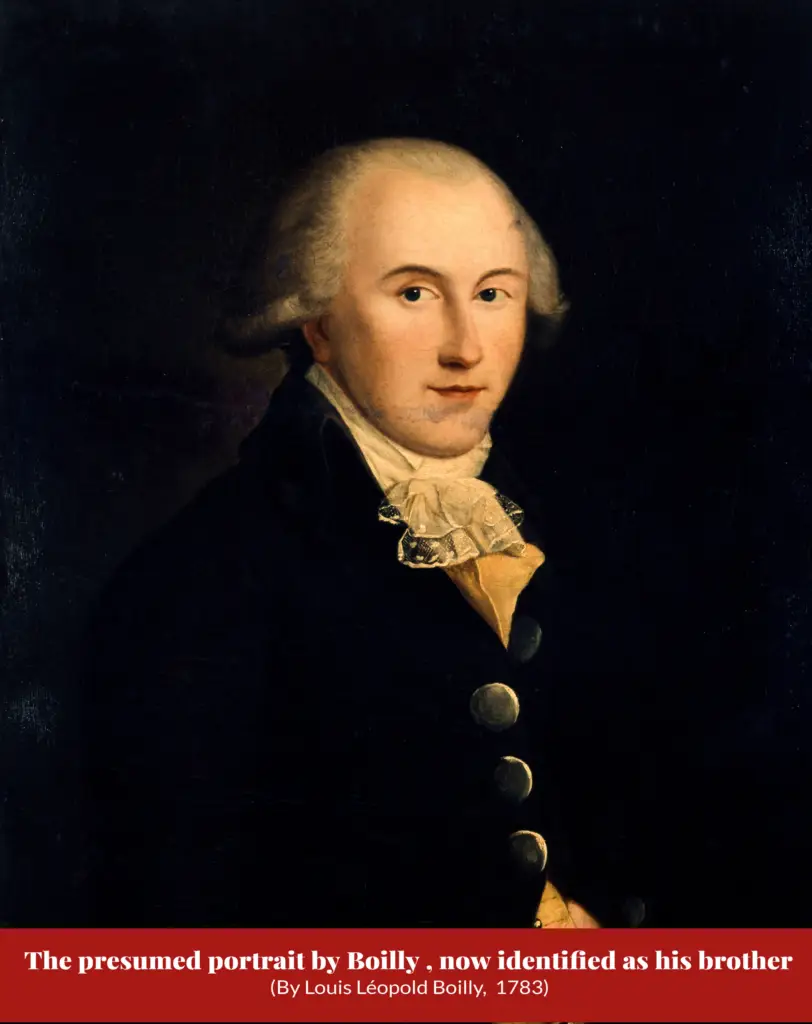
The twentieth-century historian Hippolyte Buffenoir claims that the painting remained in the Robespierre family for a long time before being bought by the Musée Carnavalet 11 in Paris. He also believes that is strong evidence of the fact that the painting indeed portrays Robespierre. At present, however, this portrait is more often thought to depict Robespierre’s brother Augustin.
Anyway, for a very long time people seemed convinced that Boilly really had painted the correct Robespierre, and that this was the picture now in Lille.

The painting shows a man in a blue late eighteenth-century coat sitting at a desk. He is looking toward the viewer, holding a snuffbox in his left hand while resting his other arm on a Louis XV armchair. A small dog stretches up toward his hand for attention, and a trunk sits in the background.
However, it is highly doubtful that this painting actually depicts Robespierre.
The identification of the sitter as Robespierre rests entirely on a 1928 article by Fernand Beaucamp. Beaucamp’s case was, to put it mildly, not overwhelming. It relied on little more than a vague physical resemblance, the sitter’s elegant hair and posture, the austerity of the room, and the presence of the trunk in the background, which he decided must symbolise Robespierre’s move to Paris.
On this basis, the fashionable gentleman with the snuffbox and attentive dog was promoted into Maximilien Robespierre before Paris. Which is possible, I suppose, in the same loose sense that many things are possible. But on the evidence itself, the far more likely conclusion is that this is simply not him.
David and the deputy
If neither of Boilly’s portraits is in fact of him, then the first known image of Robespierre would date from the start of his political career in Paris. And, chronologically at least, his first depiction would not be a simple portrait but something much grander: a suitably dramatic appearance as part of an ensemble.
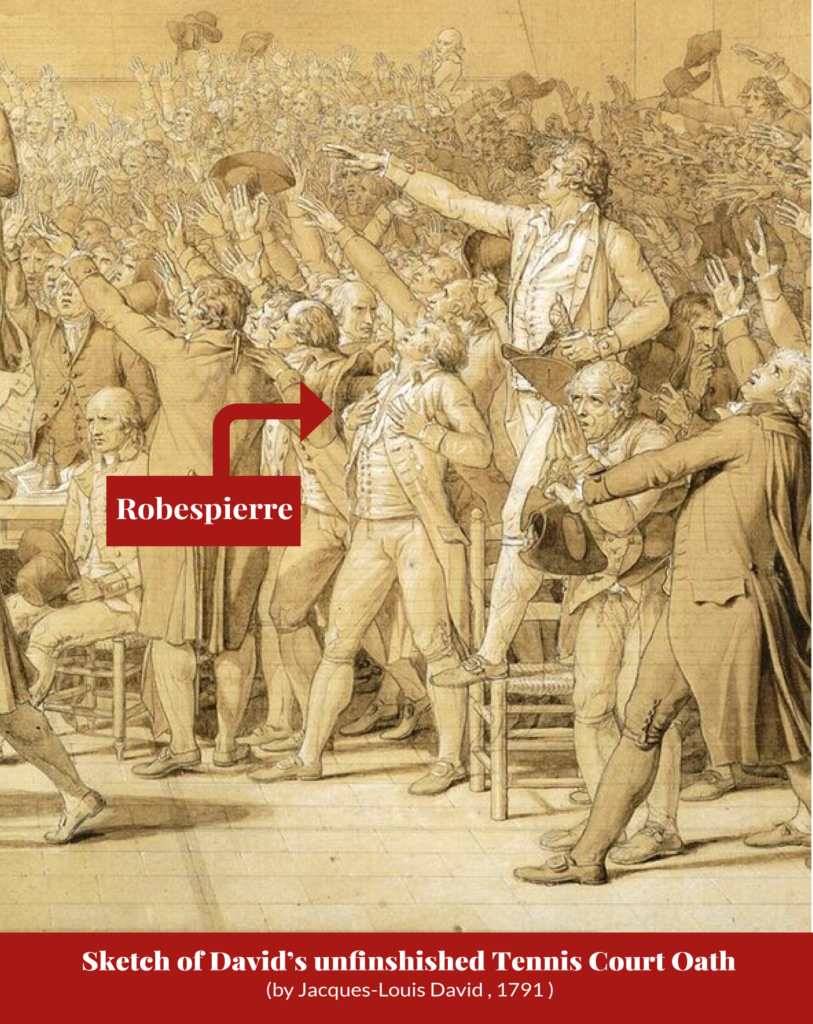
I am speaking, of course, of Jacques-Louis David’s 12 drawing of the Oath of the Tennis Court 13, shown at the Salon 14 in September 1791. Robespierre stands to the right of Jean-Sylvain Bailly 15. David gives him his right foot forward, chest thrust out, head tilted slightly back, eyes lifted toward the sky through the high windows. His hands are spread across his chest in a pose of admirable restraint. He looks like a man fully prepared to die for the Constitution.
That was not David’s only image of Robespierre. He also seems to have painted a full-length portrait of him sometime in 1791, though the original has disappeared, which is inconvenient. Because the painting itself is missing, it is known mainly through an engraving by an artist named Fischer.
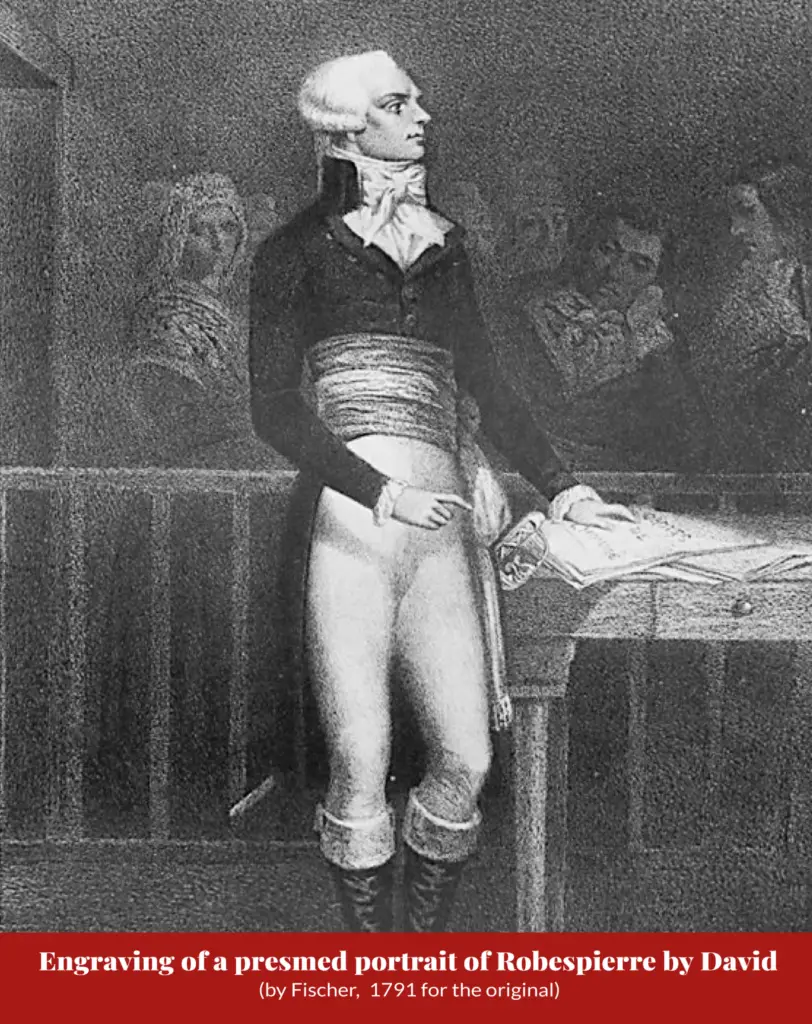
Based on that engraving, David’s portrait showed Robespierre standing at the Jacobin Club 16, just about to take the floor, with his right hand raised in an oratorical gesture. In the shadowy background, citizens listen attentively. He is dressed in the official costume of a representative of the people, complete with a broad sash tied at the waist, a sword with a Phrygian cap on the hilt, a large white cravat, a long-tailed coat, and cuffed boots. His left hand rests on a table holding papers marked Droits de l’homme 17.
This is, of course, an engraving of a lost painting, so we have no real way of knowing how faithfully Fischer reproduced the original.
Still, in his version Robespierre looks properly heroic, very much in keeping with the way David staged him in the Oath of the Tennis Court, if perhaps a little taller than reality seems to have allowed.
The Incorruptible
At that same Salon in 1791, Adélaïde Labille-Guiard 18 exhibited a pastel portrait of Robespierre. He appears elegantly dressed in the black clothes associated with deputies of the Third Estate 19. His face is young, smiling, at ease, and faintly pink. At the bottom of the work, the artist inscribed the title “The Incorruptible.”
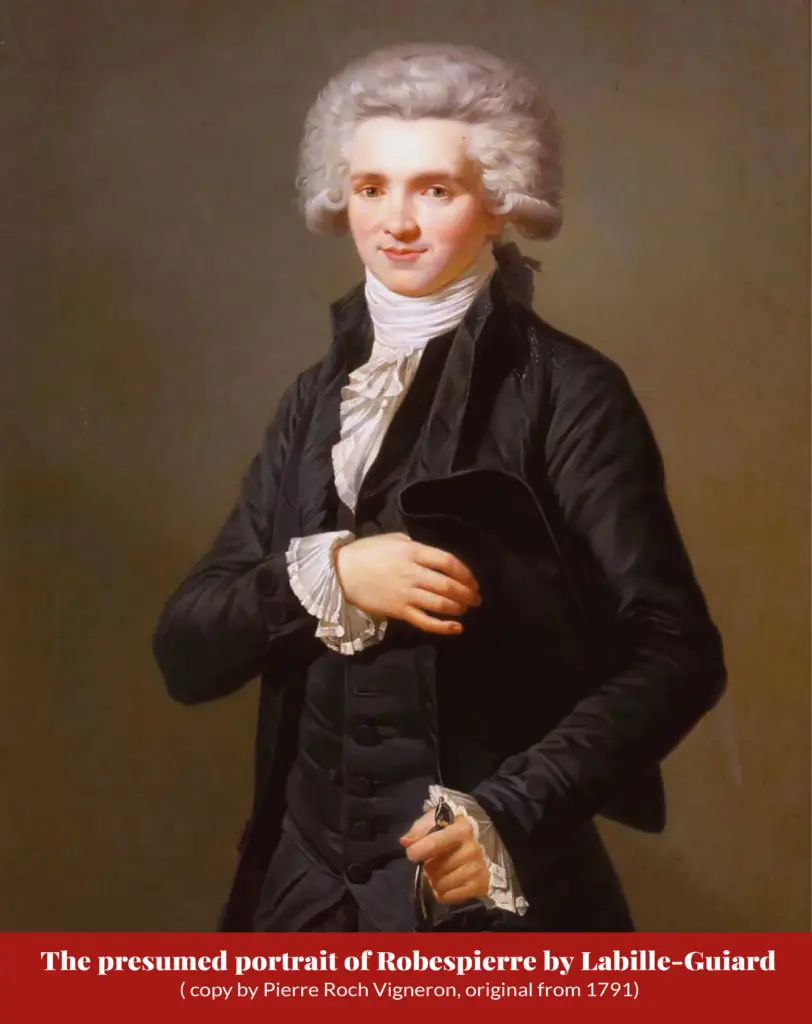
Robespierre did in fact sit for this portrait. In a very courteous, rather charming letter of 13 February 1791, now kept in the British Museum, he accepts a sitting:
I have been told that the Graces wished to paint my portrait. I should count myself most fortunate to receive such a favour, since I so keenly appreciate its value. Yet, whether because an excess of difficulties and business, or because some jealous god, has so far prevented me from showing them all the eagerness I feel, my apologies must come before the homage I owe them. I therefore beg them kindly to accept the former, and to let me know on what days and at what hours I might offer them the latter.
The portrait was a major success at the 1791 Salon. Contemporary art critics praised its truthfulness and its drawing. Another artist, Joseph Boze, exhibited his own pastel of Robespierre at the same exhibition, but one critic remarked that Boze’s attempt failed beside Labille-Guiard’s, and advised the deputy to keep having his portrait done by women.
Unfortunately, Labille-Guiard’s original pastel is now lost, and historians do not know what became of it.
Because the original is lost, there has been considerable confusion in the art world, since the only thing that remains of it is this reproduction by Pierre Roch Vigneron, now in the collection of the Museum of Versailles, and at times attributed to Henri-Pierre Danloux.
The main argument critics make against Vigneron’s reproduction being taken for her painting is that her work was, in fact, a pastel. Given that, it is also doubtful whether the subject of the painting at Versailles is really Robespierre.
Robespierre by Boze
Joseph Boze 20 was a French portrait painter who worked at the court of Louis XVI and continued into the Revolution. He is generally credited with three portraits of Robespierre: one pastel and two drawings.

Boze showed a pastel portrait of Robespierre at the Salon des Tuileries in September 1791. It presents him in an oval frame, turned three-quarters, wearing a blue coat with a generous lace cravat. The background and the face are dominated by warm golden-brown tones.
I tend to like this pastel. The expression is thoughtful, almost pensive.
Contemporary critics were less receptive. They judged it inferior to the pastel shown by Madame Guyard at the same Salon. One remarked that it made Robespierre look “all yellow and all pale,” while another said Boze had “failed” the likeness and suggested he leave such portraits to women. The pastel is now kept at the Musée Lambinet in Versailles.
Boze is also associated with two drawings of Robespierre.
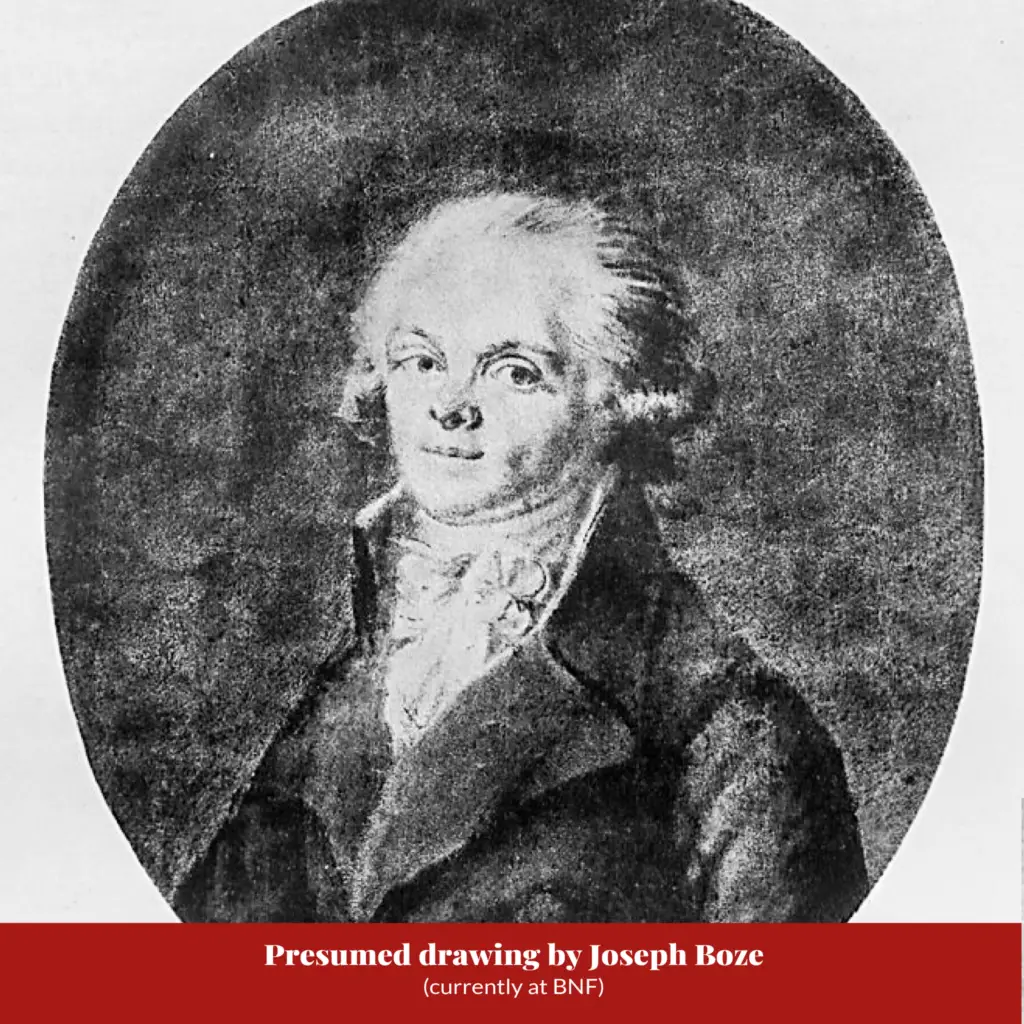
The first, noted by Hippolyte Buffenoir, was apparently given to the Cabinet des Estampes 21 by Marat’s sister, which led him to suppose it may once have belonged to Marat. It shows Robespierre in an oval medallion, facing forward against a dark ground, in a coat with broad lapels and a full white cravat. Usually dated to the time of the Constituent Assembly 22, it is valued for its youthful but severe expression and its steady gaze.
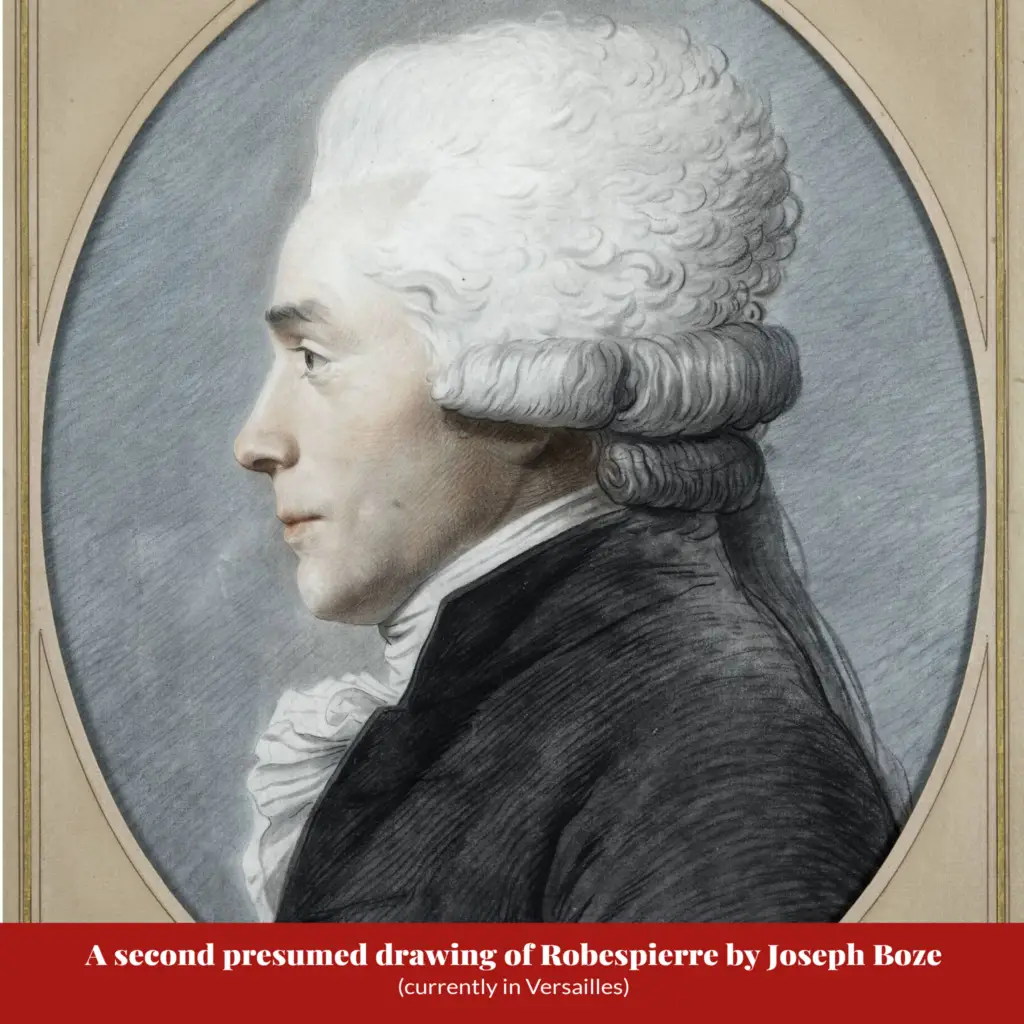
The second is a drawing in two pencils on pink paper, now at the Musée de Versailles. Donated by Ch. Vatel, a note on the reverse states that it came from Boze’s own collection and records a “striking” and “natural” likeness of the Incorruptible.
The man disguised as robespierre
At the Musée Carnavalet, there is a painting that long passed as a portrait of Robespierre (not the one you’re thinking of! We’ll get there). It came to the museum through the collection of Ernest Hamel.

It was a life-size oil, signed and dated 1792, and it showed a seated man with papers in his hands. The canvas also carried the signature of the artist, H. Lefèvre and an inscription identifying the sitter as “MAX. ROBESPIERRE, DÉPUTÉ DU DÉP DE PARIS 23”.
During cleaning in 1988, it became clear that the painting had been altered. The sitter’s features had been painted over to make him resemble Robespierre, and the identifying inscription had been added later as well. Those additions were not original.
So this painting of Robespierre is now the painting of a random 18th century guy.
The Lost Gerard Painting
François Gérard 24 painted a full-length portrait of Robespierre that apparently served as the main decoration in the salon of the Duplay 25 family. Tragically, this painting was only preserved until 1815, when it was destroyed in a fire.It is unknown if any engravings were ever made that captured this specific full-length composition. That being said, fortunately, a second work by Gérard survives: a half-body sketch drawn from life during a session of the National Convention 26, which the artist enhanced with watercolor.

This sketch, which later belonged to the collection of Georges Duruy, is believed to have possibly served as a preparatory study for the destroyed full-length painting. It also became a highly influential image in the 20th century, as it was the primary portrait chosen to represent Robespierre in the widely used Malet-Isaac 27 school textbooks.
It also happens to be my favourite representation of Robespierre.
Unlike most portraits which omit them, Gérard’s sketch specifically depicts Robespierre with his signature small, round tinted glasses pushed up onto his forehead.
The bottom of the sketch features a specific handwritten note describing his colouring and attire: “Green eyes, pale complexion, green-striped nankin 28 coat, blue-striped white waistcoat, red-striped white cravat”.
Did Fragonard paint Robespierre?
Jean-Honoré Fragonard 29, of The Swing fame, was a prolific eighteenth-century French painter whose late Rococo style is almost emblematic of the elegance of the pre-revolutionary French elite. Not exactly the most obvious choice for a portraitist of Robespierre.

According to Buffenoir, he had a masterful oil bust of Robespierre whose technique and expressive workmanship strongly recall Fragonard’s style. This portrait shows Robespierre facing forward but turned to the left, wearing his signature blue coat and a high cravat with a jabot. His face appears emaciated, meditative, and sad, which led him to think it was painted during a period of exhaustion shortly before his downfall on 9 Thermidor.
That being said, Buffenoir does not claim that the painting in his possession is by Fragonard, only that it resembles one. He is, however, quite sure that Fragonard did paint Robespierre in a round fresco medallion on the grand staircase of the Maison Malvilan in Grasse, the artist’s hometown. That portrait shows a bust of Robespierre in profile, with a strikingly youthful, smiling expression, along with a high white cravat and jabot.
The identity of the subject sparked a lively debate in the journal La Révolution française in 1900. The critic M. F. Rabbe attributed the work to Fragonard, arguing that the artist was struck by the youthful regularity of Robespierre’s features. By contrast, the playwright Victorien Sardou argued that while the fresco may have been painted by Fragonard, the subject was certainly not Robespierre.
The historian J. Guillaume defended the attribution by noting that Fragonard visited Grasse around 1790 or 1791, when Robespierre was already famous. Guillaume suggested that Fragonard likely painted the Incorruptible from memory, which neatly explains the unusually smiling and relaxed depiction. Buffenoir agreed with this view, concluding that until proven otherwise, the fresco is an authentic depiction of Robespierre.
As for me, my family lived near Grasse for almost ten years (they moved away five years ago), and I visited the Musée Fragonard more than once. I don’t recall ever seeing this portrait. It may well still be there; if so, I missed it.
The Marseille Portrait
A little-known possible portrait of Robespierre is an 18th-century oil on canvas now held at the Musée de Longchamp in Marseille, which acquired it in 1898. It is officially catalogued as a “Presumed portrait of Robespierre.” The work came from the Nadar 30 family.

Unlike the usual profile images of the Incorruptible, this one shows him almost full-face, shoulders turned slightly to the left against a muted green ground. The sitter has powdered hair and a pale complexion, with a faint flush at the cheekbones. He wears a greenish-grey coat with a high, open collar and broad lapels, and a white cravat edged in red, laid flat without knot or bow.
Paul Nadar, the donor’s son, said the painting had been in the family since his childhood, though how his father obtained it was unclear. He did recount one episode: sometime between 1868 and 1870, a maid employed by their landlord on the Boulevard des Capucines stole the painting. His father later recovered it after visiting her during an illness and finding the portrait in her room.
The painting was identified by the historian Joseph Letaconnoux, who based his claim on the expected features: pronounced cheekbones, flat cheeks, a forehead compressed at the temples, a slightly upturned nose with broad nostrils, a short, pointed chin, and deep-set eyes under heavy lids.
The artist is unknown. When the museum acquired the work, its director attributed it to the 19th-century Provençal painter Philippe Tanneur, but that has not held; neither style nor date align. Other suggestions include Fanny Boze, perhaps working in hopes of leniency for her imprisoned father, Joseph Boze, or the Arras painter Doncre.
The wig-less Robespierre by Bouteville
Another now-lost original portrait of Robespierre, painted by Bouteville, was a contemporary oil. It showed him as a bust in left profile, with a youthful face and a severe expression. Notably, he appears without a wig, or with one at least less heavily powdered than usual.

The painting itself is lost, or at least untraced. Buffenoir suggested it may still exist somewhere in England. What remains is an English engraving made from it in 1794 by an artist named Jones.
The surviving engraving by Jones takes the form of an oval medallion, 12.5 centimetres high and 10 centimetres wide, with a double framing line and a border hatched in horizontal strokes. Robespierre’s bust appears in left profile against a dotted black ground.
Beneath the frame is the signature “Jones Sculft.” Below that, a two-line English inscription reads: “M. Robbespierre , From an original Picture by Bouteville”.
Yet Another Versailles Portrait
There is another portrait at Versailles, better known, at least to me, as the one used on the cover of Hervé Leuwers’s 2014 biography, Robespierre.
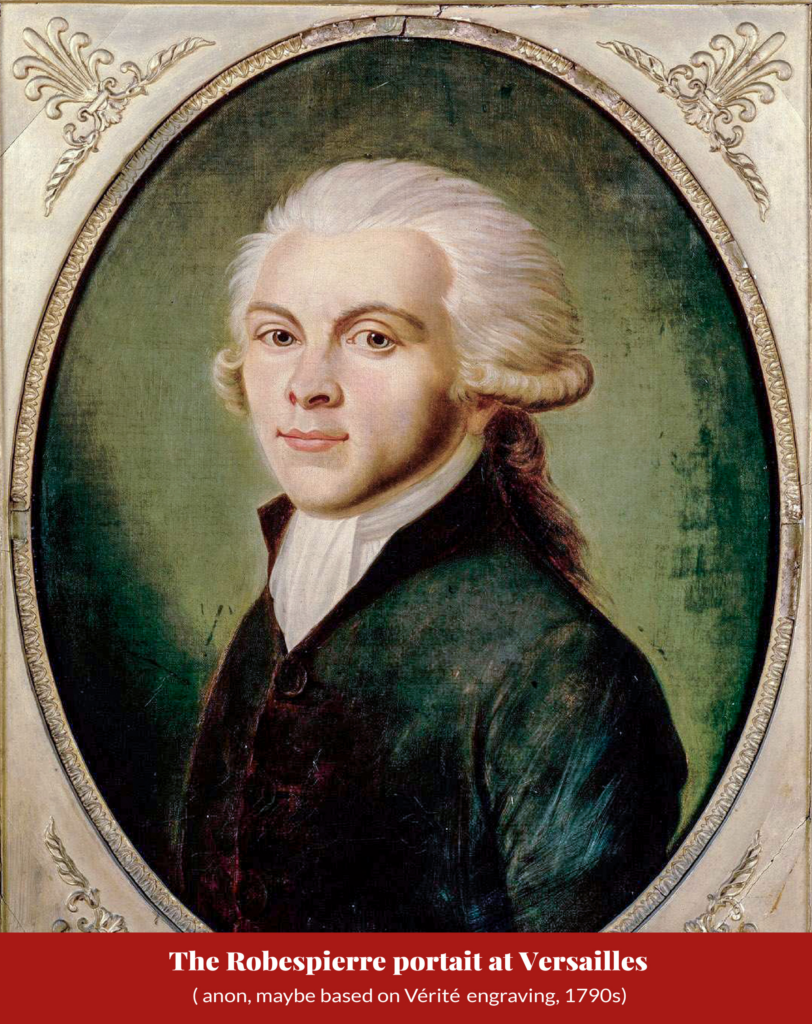
The painting is an anonymous oil on canvas showing Robespierre in three-quarter view, dressed in a brown jacket set off by a fairly plain white cravat.
What makes this anonymous painting notable is its striking resemblance to a well-known contemporary engraving by Vérité. That engraving, titled Maximilien Marie Isidore Robespierre, député de la province d’Artois, was explicitly presented as having been drawn “from life”. It shows him with a somewhat full face, reflecting, as Buffenoir puts it, (I’m paraphrasing) a serious, virile gravity and a contained strength.

Because the two works are so close, historians such as Leuwers suggest that the painting and the engraving probably share a common history. The exact relationship, though, remains obscure. It is not clear which came first. So we do not know whether the anonymous painter used Vérité’s engraving as the model for the canvas, or whether the oil painting came first and served as the original source for the engraving.
The most famous of them all: Carnavalet Painting
We cannot talk about the imagery of Robespierre without talking about his most famous portrait: the one I used myself as the basis for my own rendition.
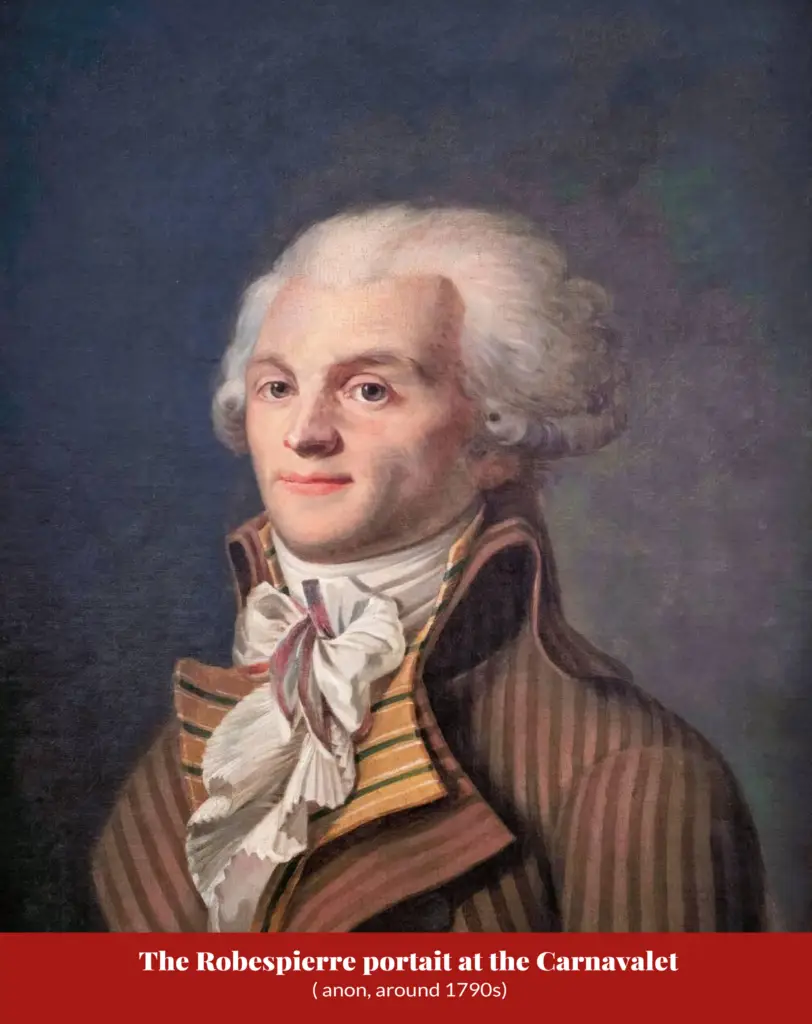
The anonymous oil painting at the Musée Carnavalet is undoubtedly the most famous and most widely reproduced image of Robespierre today, fixing the modern visual cliché of him as an elegant gentleman dressed in the style of the Ancien Régime. The portrait shows him in a three-quarter bust view, with a pleasant, faintly smiling face. He is carefully dressed in a striped nankeen coat, a green-and-white striped waistcoat, and a high white cravat with a large knot and jabot, notably without his signature round glasses.
It is an image that has since become iconic, and has appeared in all sorts of media, including, in my view, the very well-done Terreur et Vertu 31.
That said, for all its fame now, not much is known about when this portrait was painted. The Carnavalet dates it to “around 1790,” and that is about it. As far as I can tell, there is no solid evidence that this portrait was drawn from life. Even so, it is remarkably close to a lithograph that does seem to have been fairly faithful to Robespierre: the 1824 lithograph by Delpech 32, drawn, by Grevedon 33.
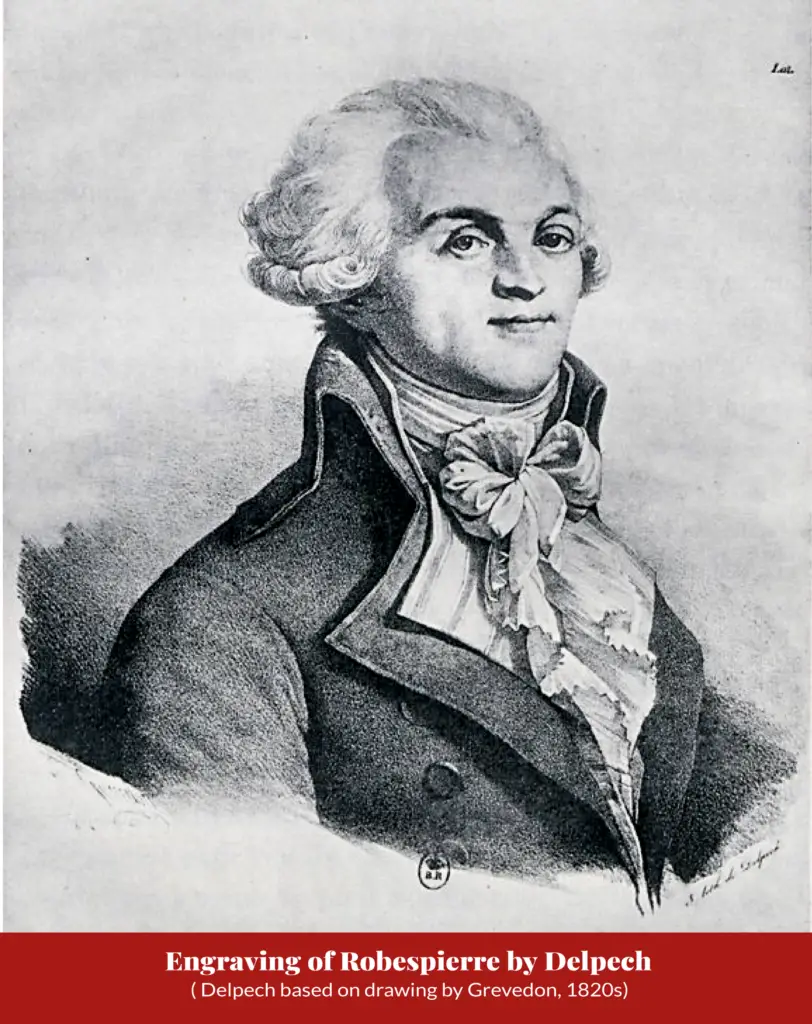
Like the painting, the lithograph shows Robespierre in a three-quarter bust view, turned to the right. He is not wearing the striped coat, though, but instead a plain dark coat over a lighter striped waistcoat with wide lapels. His neckwear is again a high white cravat tied in a large, bunched knot, along with a prominent shirt frill or jabot.
The Delpech lithograph carries a bit more historical weight because Robespierre’s sister strongly endorsed it. Charlotte Robespierre wrote in her memoirs that, despite the large number of portraits published of her brother, the one by Delpech was the most accurate and the closest likeness of all. When Charlotte died in 1834, the modest inventory of her belongings included a lithographed portrait of Maximilien, which Buffenoir confidently believed was this very Grevedon-Delpech print that she valued so highly.
So, in short, the Musée Carnavalet painting resembles the Delpech engraving, which was based on a drawing by Grevedon that his sister recognised… so it might be accurate-ish. Maybe. Who knows. Anyway, it is a great portrait.
Random Paintings
As I said, Robespierre was painted a great many times, and these are a few extra portrait paintings I could find, though not all of them could be properly identified from the sources I had. Quite a few were gathered by Hippolyte Buffenoir in a study from the 1910s, which does not seem to have been seriously revisited since, so I will leave the degree of Robespierre-ness to your judgement.
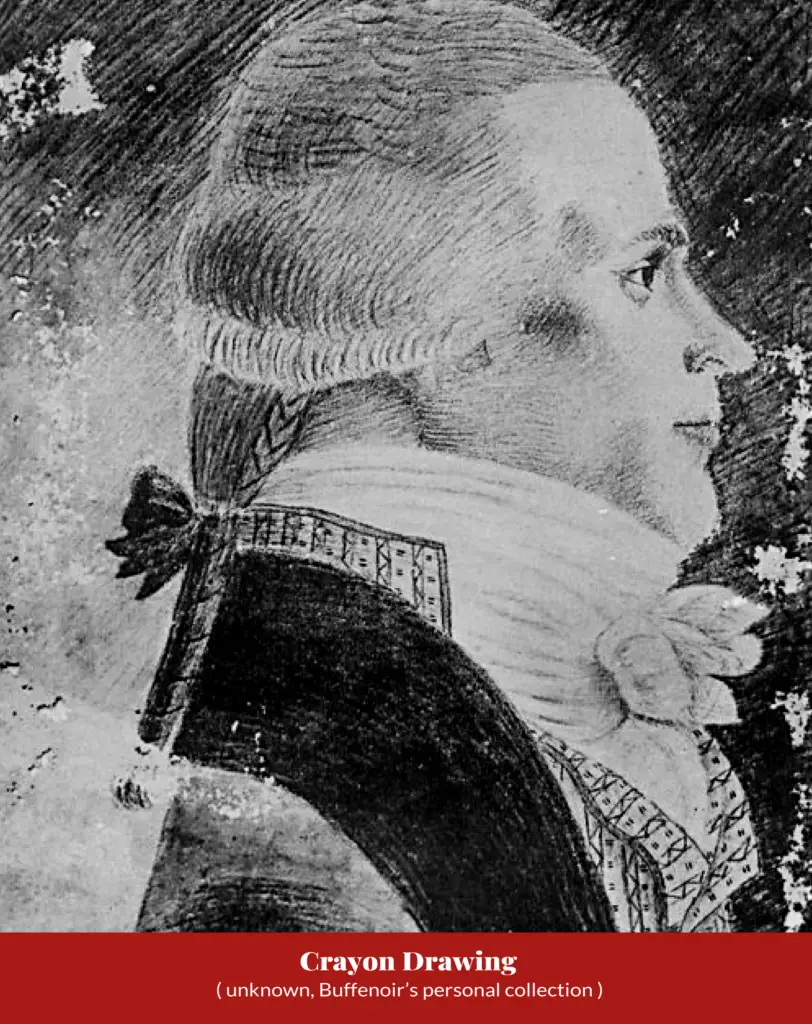
This is an original drawing done in three crayons in the manner of a pastel. It is slightly under life-size and shows Robespierre in right-facing profile. He wears a powdered wig with a queue tied in a bow, and a high-collared embroidered coat. Buffenoir notes that the eyes are rendered with particular mastery, capturing a concentrated inner life and an indomitable force of will. The artist is unknown, and the work was in Buffenoir’s own collection.
This is an unsigned, life-size oil painting, which Buffenoir acquired after the death of its previous owner, the writer Arsène Houssaye. It shows Robespierre as a bust in profile facing right, though turned slightly toward the viewer. He wears a blue coat and a large white cravat with a puffed knot. The figure is placed against an oval background, itself set within a painted square frame. It was exhibited publicly at the Galerie Georges Petit in June 1893.

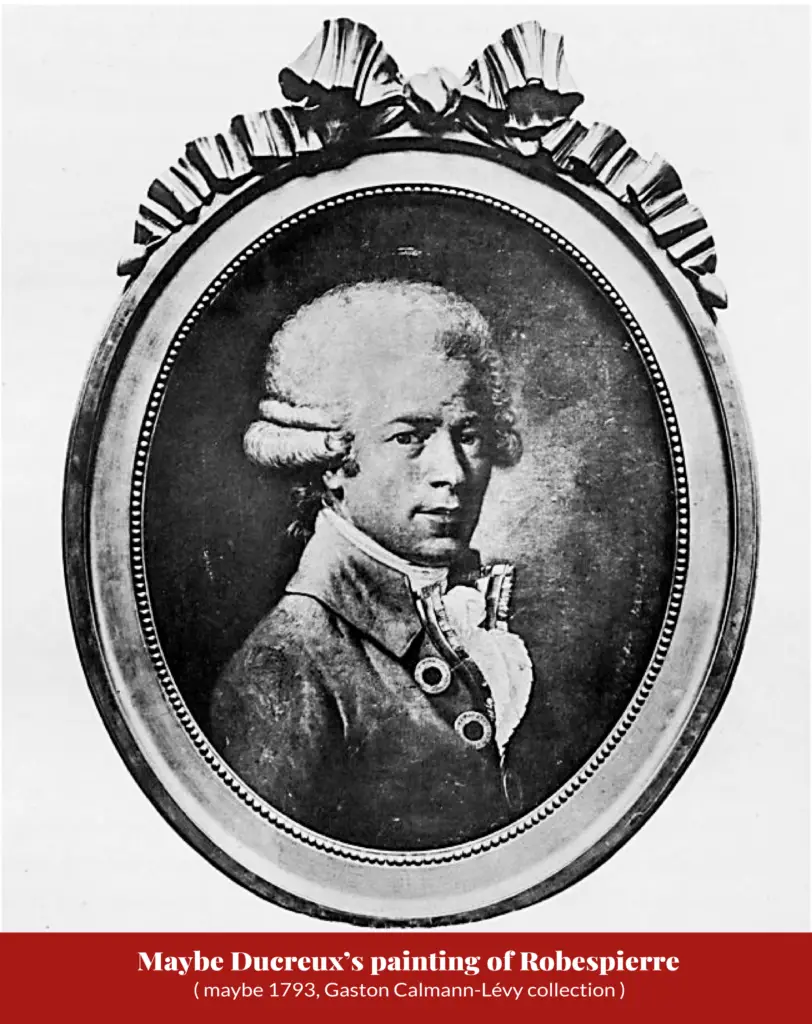
From the Gaston Calmann-Lévy collection (and previously in the Montesquieu family), this near life-size oil painting shows a three-quarter bust of Robespierre facing right. He wears a blue coat with large buttons, a prominent jabot, and a powdered wig against a pale grey background. The painting sits in an oval frame decorated with a ribbon bow. The face is full of life and serious, though without any severe stiffness. Because of its highly expressive and virile handling, Buffenoir firmly attributes it to Ducreux, who is known to have exhibited a portrait of Robespierre at the Salon of 1793.
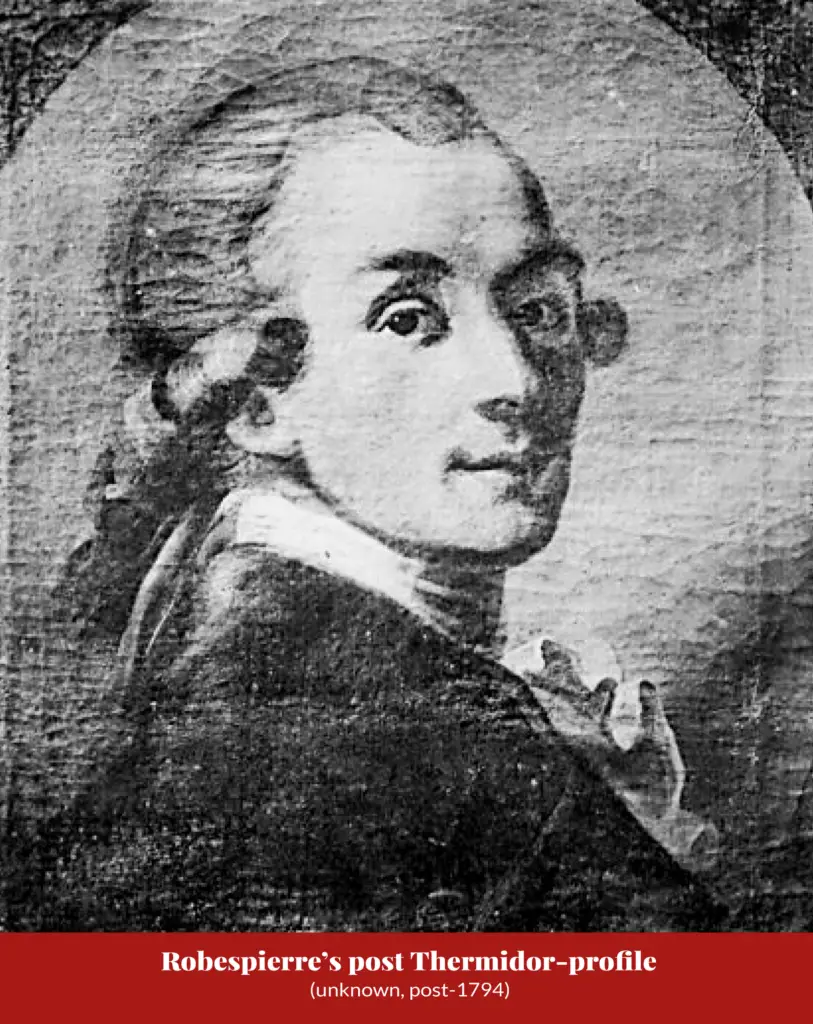
This is an oil painting, which Buffenoir dates to late 1790 or early 1791. The composition is unusual: the body is turned completely in profile to the right, but the face looks directly back over the shoulder at the viewer. He gives off youth and sympathy, wearing a puce-coloured coat with wide lapels, a folded collar, and a high white cravat. The background is a light, watery grey-green, set off by a painted puce oval frame. On the back of the canvas is an old inscription summarising his life, noting that he was “attacked and defeated by a 10 Thermidor.”
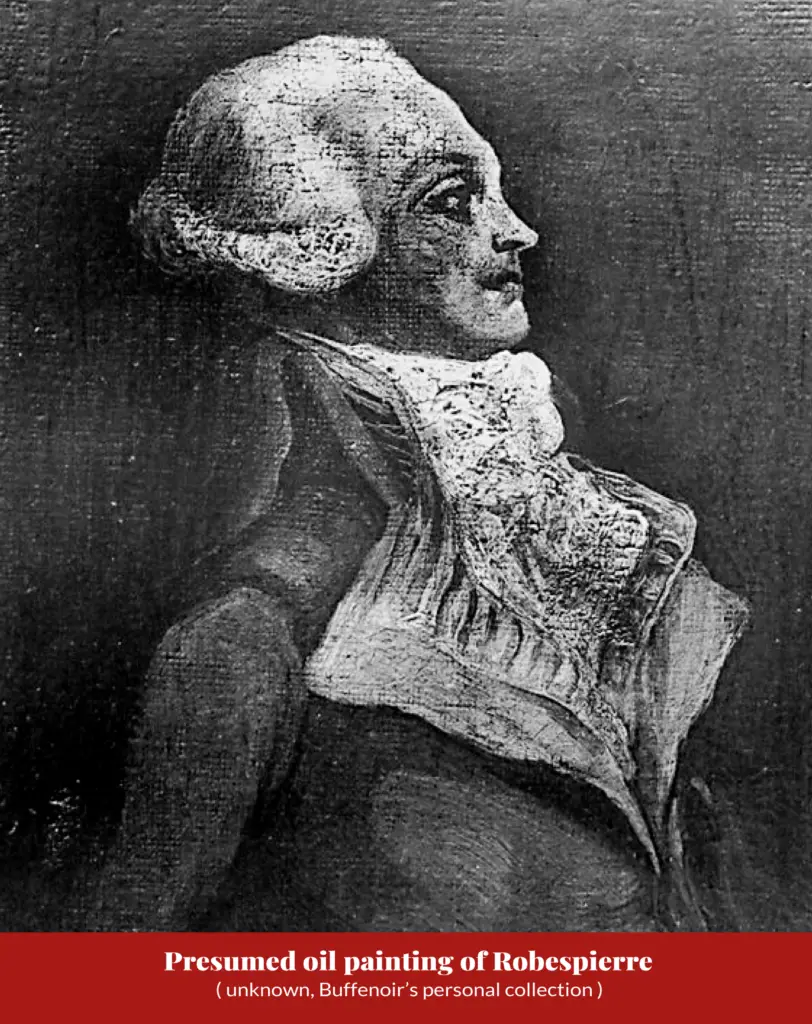
This unpublished painting from Buffenoir’s collection is a very small oil on canvas (0.14 m wide by 0.19 m high). It shows Robespierre half-length, in profile facing right, caught in the lively posture of an orator about to begin. He wears a buttoned blue coat, wide lapels edged by the striped lapels of the waistcoat underneath, a high white cravat with a puffed knot, and a jabot. His head is tilted slightly back, and his grey-black eyes are wide open, rendering perfectly his fine and simple elegance.
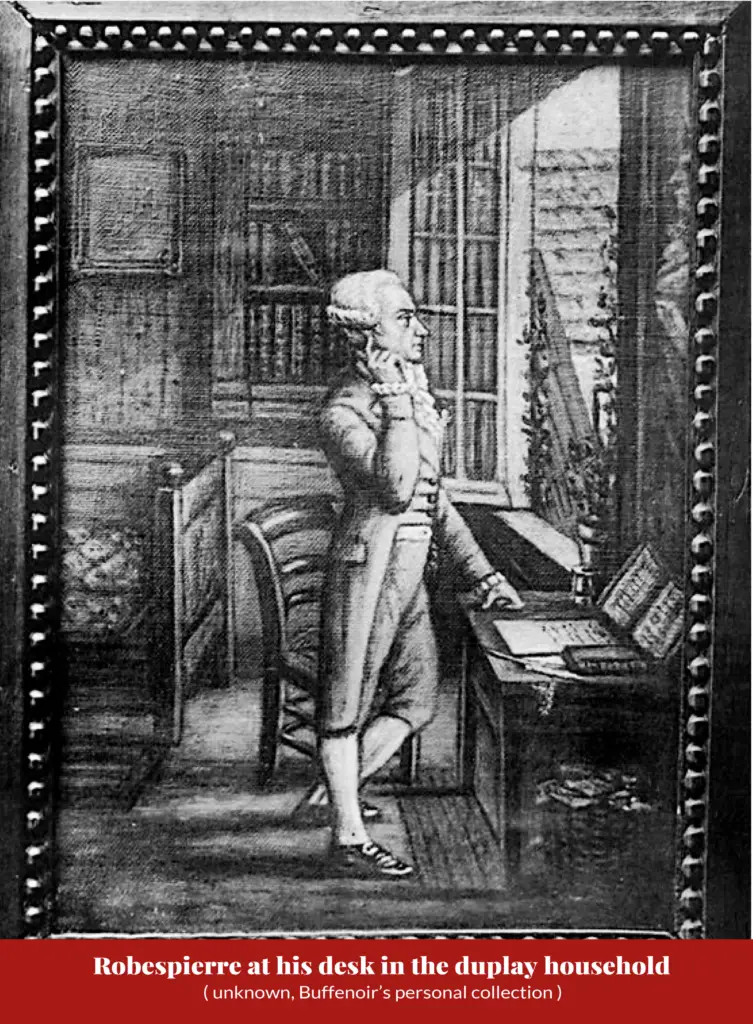
Considered by Buffenoir one of his most historically precious artefacts, this small, anonymous painting shows Robespierre inside his actual modest room in the Duplay house, at 398 Rue Saint-Honoré. For Buffenoir, the exactness of the detail suggests the artist painted it on the spot. It shows the simple bed, the work table, portraits on the wall, and an open window looking onto the Duplay workshop with its planks of wood. A flowering potted plant sits on the sill. Though it is often described as showing him meditating “at” his desk, the painting in fact shows him standing, one hand resting on the table and the other supporting the right side of his face. He is dressed in his cornflower-blue coat, nankeen trousers, white stockings, buckled shoes, and lace jabot.
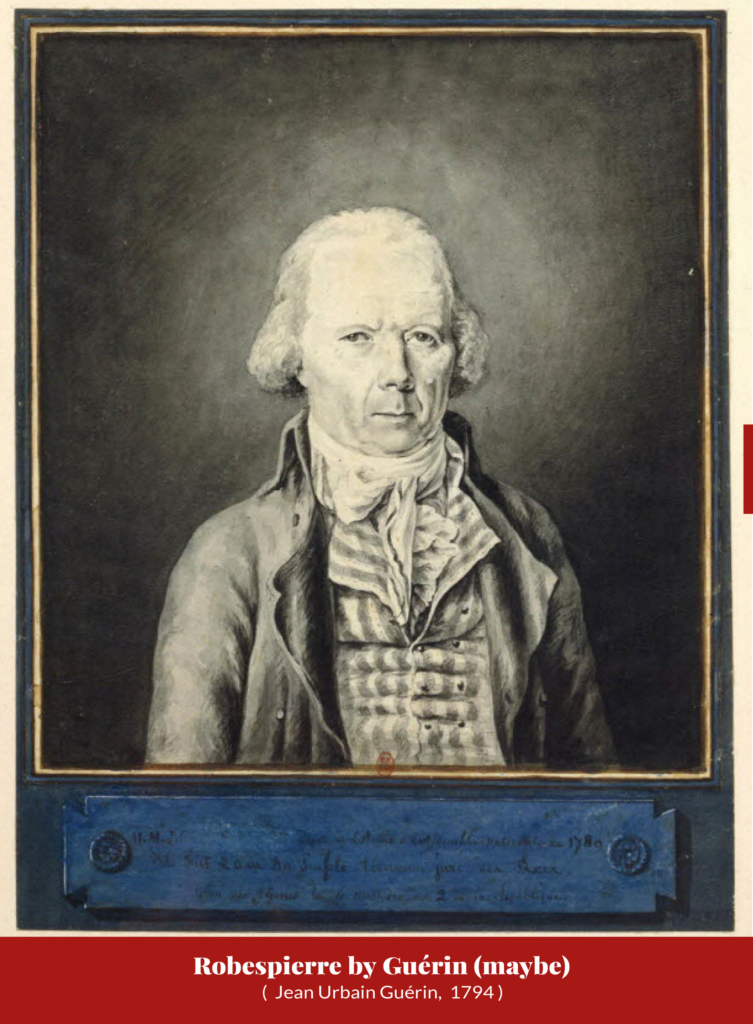
This one, I have no idea where it actually comes from, but the notice at the Bibliothèque nationale de France says it is the work of Jean Urbain Guérin and that it is a painting of Robespierre from 1794. Now, to me, it does not look like him at all. The clothing has some resemblance, yes, but I cannot imagine a man that fastidious allowing himself to be painted like this. If anything, given the date, I would assume it belongs to the wave of Thermidorian propaganda imagery that followed Robespierre’s death. But that is a problem for another day.
And because I cannot let that be the last image in this very long article about Robespierre’s portraits, here again, and in better detail, is the portrait of him I like best and cannot stop staring at… I mean, I’m super biased, but it’s so much prettier than the previous one…
Footnotes
- 1The Ancien Régime means the political and social order of pre-Revolutionary France, that is, the monarchy, the system of legally privileged estates, and the social hierarchy that existed before 1789.
- 2The sans-culottes were an urban political movement, especially strong in Paris, associated with militant popular radicalism during the Revolution. Their name literally means “without knee-breeches”, since they favoured long trousers rather than the silk breeches of the social elite;
- 3The carmagnole was a short jacket associated with Revolutionary activists, and the red Phrygian cap became a widely recognised emblem of liberty and popular Revolution.
- 4These are all items of late eighteenth-century dress. Culottes were knee-breeches; a cravat was a neckcloth tied round the throat; a jabot was the frilled linen or lace front at the shirt opening; and nankeen was a light, usually yellowish cotton cloth originally associated with Nanjing in China.
- 5The Festival of the Supreme Being was a civic-religious festival held in Paris on 8 June 1794, created under Robespierre’s influence as part of an attempt to promote a state-backed deistic civic morality. It became one of the most famous and controversial spectacles of the late Revolution
- 6Thermidor was a month in the French Republican calendar. 9 Thermidor Year II corresponds to 27 July 1794, the day on which Robespierre was arrested in the National Convention; he was executed the next day. When I am talking about Post-Thermidor , I am referring to the the political and cultural aftermath of his fall, when many hostile images and narratives about him were produced
- 7Arras is the city in northern France where Robespierre was born and later trained and worked as a lawyer before the Revolution. It belonged to the historical province of Artois.
- 8Jules Michelet (1798-1874) was one of the great nineteenth-century historians of France and a hugely influential historian of the French Revolution.
- 9The Rosati were a literary and convivial society founded near Arras in 1778, remembered for verse, sociability, and a mildly playful pastoral culture rather common during the period.
- 10Louis-Léopold Boilly (1761-1845) was a prolific French painter and draughtsman known for portraits and genre scenes.
- 11The Musée Carnavalet is the City of Paris museum devoted to the history of Paris. It has a substantial collection on the French Revolution.
- 12Jacques-Louis David (1748 – 1825) was the most celebrated painter of the French Revolution and later of the Napoleonic period.
- 13The Tennis Court Oath was the pledge made on 20 June 1789 by deputies who had been locked out of their usual meeting hall and moved instead to an indoor tennis court at Versailles, where they swore not to separate until France had a constitution. The episode became one of the foundational moments of the Revolution because it showed that sovereignty lay in the nation rather than solely in the monarch.
- 14The Salon was the principal official art exhibition in Paris, organised under academic and state authority. In late eighteenth-century France, to show a portrait there was to present it to the widest and most influential public audience available, including critics and political observers.
- 15Jean-Sylvain Bailly (1736-1793) was an astronomer and statesman who presided over the assembly at the Tennis Court Oath.
- 16The Jacobin Club was the best-known and most politically influential club of the French Revolution. Founded in 1789, it evolved from a debating society of deputies into a nationwide political network, and by 1793 it had become closely associated with republican politics.
- 17Droits de l’homme refers to the Declaration of the Rights of Man and of the Citizen of 1789, one of the Revolution’s foundational texts.
- 18Adélaïde Labille-Guiard (1749-1803 )was a major French portraitist of the late eighteenth century and one of the most important women artists of her generation.
- 19The Third Estate was the legally defined estate that included everyone in the kingdom who was not clergy or nobility, and in 1789 its deputies became central to the opening phase of the Revolution. Deputies of the third estate would wear black clothing.
- 20Joseph Boze (1746-1826) was a famous portrait painter who worked under Louis XVI and continued through the Revolutionary years.
- 21The Cabinet des Estampes is the historic prints and photographs department of the Bibliothèque nationale de France
- 22The National Constituent Assembly was the assembly that ruled France from 1789 to 1791 while drafting the country’s first written constitution of the Revolution. Formed out of the National Assembly in July 1789, it belonged to the phase of the Revolution that sought to replace absolute monarchy with a constitutional one
- 23This means “député du département de Paris”, that is, deputy for the department of Paris, the capacity in which Robespierre sat in the National Convention after his election in September 1792
- 24François Gérard (1770-1837) was a French painter, later famous under Napoleon, who also worked during the Revolution.
- 25The Duplay family were Parisian carpenters and householders with whom Robespierre lodged for years at 398 rue Saint-Honoré.
- 26The National Convention was the assembly that abolished the monarchy and governed France from September 1792 to October 1795.
- 27Malet-Isaac refers to the immensely influential French school history textbooks associated with Albert Malet and Jules Isaac.
- 28Nankin or nankeen was a pale yellow or buff cotton cloth, originally imported from China and named after Nanjing, though the term was later also used for European imitations. In late eighteenth-century dress it was commonly used for light, fashionable garments such as breeches and coats.
- 29Jean-Honoré Fragonard (1732-1806) was one of the best-known painters of the late French Rococo, now especially famous for The Swing. Rococo refers to the ornate, elegant, playful style associated with much elite mid- and late eighteenth-century art.
- 30The Nadars were a famous nineteenth-century French family of photographers and cultural figures, closely associated with a celebrated studio on the Boulevard des Capucines in Paris.
- 31La Terreur et la Vertu was a two-part French historical television drama directed by Stellio Lorenzi and first broadcast in 1964 as part of the series La caméra explore le temps. The first part is about Danton, the second about Robespierre. Go watch them. They’re great!
- 32François-Séraphin Delpech (1778-1825) was a French lithographer and publisher
- 33Pierre Louis Grevedon (1776-1860) was a French painter, lithographer and illustrator
Sources & further reading
- Buffenoir, Hippolyte. “Les Portraits de Robespierre (Suite).” Annales révolutionnaires 2, no. 1 (1909).
- Buffenoir, Hippolyte. “Les Portraits de Robespierre (Suite et fin).” Annales révolutionnaires 2, no. 3 (1909).
- Buffenoir, Hippolyte. Les Portraits de Robespierre : étude iconographique et historique, souvenirs, documents, témoignages. Ernest Leroux, 1910.
- Letaconnoux, Joseph. “Un portrait inconnu de Robespierre.” Annales révolutionnaires 4, no. 2 (1911).
- Beaucamp, Fernand. “Un portrait inconnu de Robespierre au musée de Lille.” Revue du Nord 14, no. 53 (1928).
- Leuwers, Hervé. “Images de Robespierre.” Humanisme, no. 325 (2019).
- Leuwers, Hervé. Robespierre. Fayard, 2014.