Usually when an English speaker is getting into the history of the French Revolution and wants to go beyond Wikipedia, they stumble on The Twelve Who Ruled. It’s inevitable. Since 1941 it has been a staple of lecture halls and history aficionados alike.
For me it was one of the first things I read, many years ago, and it shaped, to some extent, how I approached the period. I read it again last year, expecting to see it differently. I didn’t. It’s an old book. But still, by the standards of 21st-century historiography, largely accurate.
So since it’s a book a lot of beginners encounter, and since I’ve had half a mind to review some of the dozens of books on the French Revolution I own, I thought it would be a good place to start.
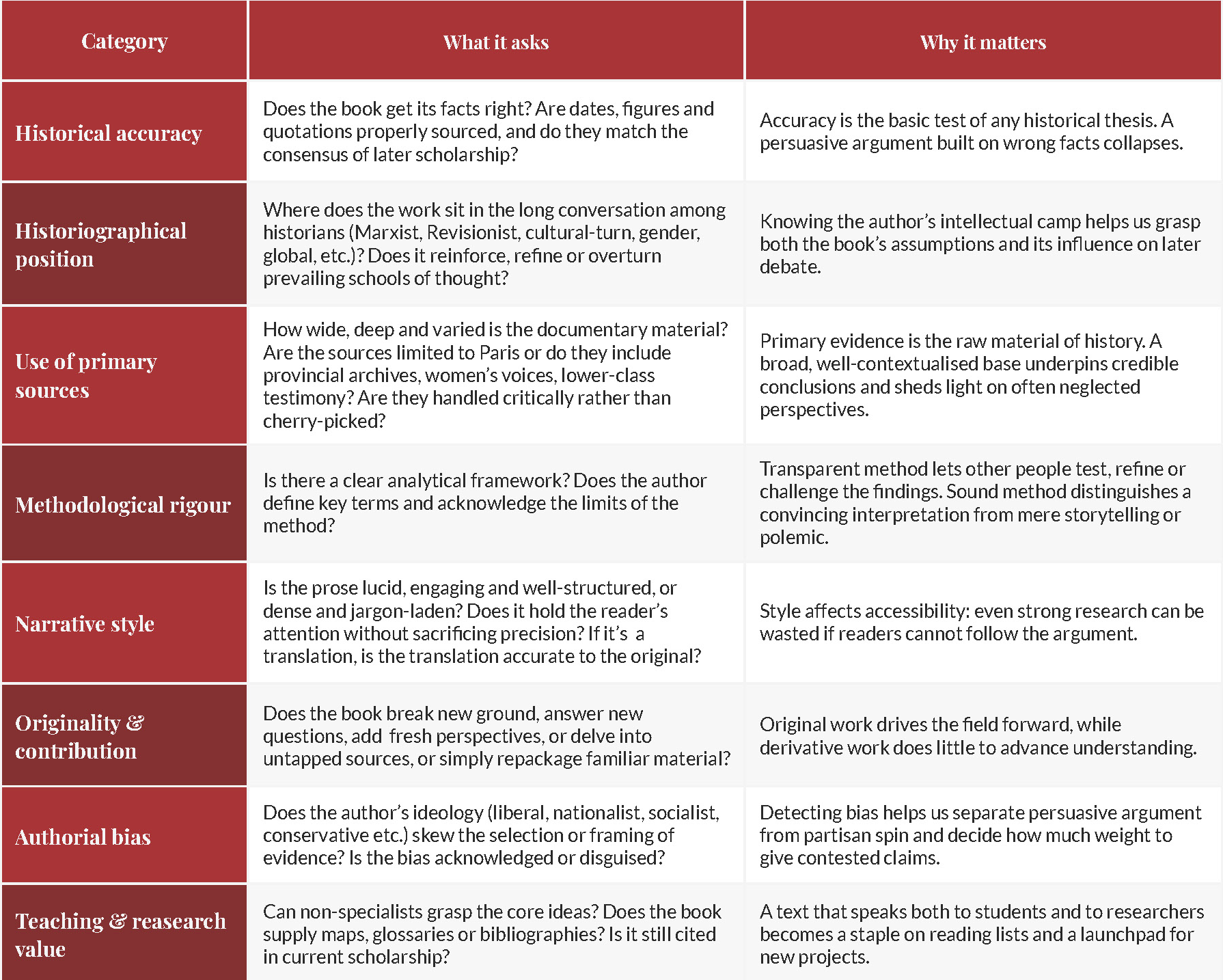
I will be assessing this book (and all others I review) on a scale from 1 to 5 in eight categories:
Before we start, remember two things:
- This is my review, which means it is, by definition, biased. I try to stay as neutral as possible, but no one is fully objective.
- You should never take anything as fact. I research things. I enjoy researching things. I spend far too much time researching things. But I’m human, and that means I make mistakes. Challenge everything you read, including this.
A note before you read. This is my review, so it is inevitably subjective. I try to be fair, but complete objectivity does not exist. I research everything as carefully as I can, but I am human and I make mistakes. Treat nothing here as unquestionable fact. Challenge what you read, including this.
4/501 Historical Accuracy
For a book published in the 1940s, Twelve Who Ruled is remarkable in how much of it remains uncontested, especially given that archival access in France was impossible during the war. Using only the printed sources available to him, Palmer built a richly detailed narrative of Year II. He avoided major factual errors and did not indulge in the lurid exaggerations or mythologising that often plagued earlier accounts of the Revolution.
On the contrary, Palmer’s portraits of key figures and events have stood the test of time. His depiction of Robespierre, for example, was unmatched in its balance, nuance and restraint when the book was published. Subsequent scholarship has generally confirmed Palmer’s factual claims. Indeed, many of his interpretations have been validated by later evidence: for instance, he is one of the first to advance the argument that the Terror’s policies were reactive responses to severe crises, rather than a premeditated program of mass violence, and that Robespierre never exercised dictatorial authority.
Eighty years later, Twelve Who Ruled still holds up as a factually sound work. Far from perpetuating discredited myths, Palmer steered a middle course, avoiding both Thermidorian clichés about a “blood-mad” Committee and hagiographic Jacobin legends.
02 Historiographical Position
When situating The Twelve Who Ruled within the landscape of French Revolution historiography, it is important to remember that Palmer was writing in 1941, before most of the major scholarly camps had fully taken shape. His work does not fit neatly into the classic categories of Marxist, Revisionist, or post-Revisionist schools 1, though it engaged with and later influenced those debates.
Palmer’s approach was essentially a liberal narrative of the Revolution’s most turbulent phase. He focused on the pragmatic demands of governance during an existential crisis, rather than on class struggle or ideological abstraction. This already set him apart from the Marxist tradition. His attention remained squarely on the actions and dilemmas of the twelve men on the Committee of Public Safety, and on the political and military pressures that shaped their decisions.
He also diverged from what would later become the Revisionist school. While Palmer shared their scepticism of class determinism, he did not embrace their emphasis on ideology as the primary driver. His account treats the Terror less as a product of revolutionary rhetoric than as a contingent response to internal collapse and foreign invasion. He was wary of overly ideological explanations.
In short, The Twelve Who Ruled occupies a distinctive historiographical position. As the first serious monograph on the Committee of Public Safety, it predates the Cold War polarities that shaped later scholarship. In my opinion, Palmer might best be described as a pragmatic liberal historian of the French Revolution. He did not write in the Marxist tradition of Lefebvre or Soboul (though he admired Lefebvre enough to translate his work), nor did he share the iconoclastic edge of later revisionists like Cobban or Furet 2.
4/503 Use of Primary Sources
Writing during World War II from the United States, Palmer relied entirely on published primary sources available in America. These included a wide range of printed materials: the proceedings and debates of the National Convention, official documents and reports of the Committee of Public Safety, as well as memoirs, letters, and revolutionary newspapers.
This breadth of material allowed him to reconstruct the Committee’s decisions and actions almost day by day, giving his narrative credibility. Crucially, Palmer did not confine himself to Paris. Because he was interested in the representatives on mission and provincial enforcement of the Terror, he also consulted sources on events in Lyon, Alsace, and Brittany. For its time, the study had a notably wide geographic scope.
Even so, Palmer’s research was limited to what was in print. He lacked access to unpublished archives, local records, or police files that later historians would use to deepen the field of social history. His source base is political and governmental. It reflects the perspective of the revolutionary authorities, not that of ordinary people.
In short, Palmer worked almost entirely with documents written by the deputies and officials (all men) who “ruled.” As a result, the book pays less attention to marginal voices 3. The result is a body of sources broad in political scope, if limited in social depth.
Palmer’s use of sources is generally careful and even-handed. He provides context for the material he cites and avoids cherry-picking. His work relies on French-language sources, as expected for the subject 4. While not archive-based in the modern sense, the research was solid enough that the book’s factual foundation has remained largely intact even after eighy years of further research.
4/504 Methodological Rigor
The Twelve who Ruled is not overtly theoretical; its strength lies in a coherent narrative framework and a clear analytical focus. In an era when many academic historians were often abandoning narrative and turning to structural or conceptual models, Palmer resisted the trend. He showed that storytelling, when anchored in analysis, could still carry serious weight. He did not invoke grand theories (Marxist class theory, Tocquevillian social theory, etc.), nor did he fill the text with historiographical jargon. Instead, he focused on applying a steady interpretive lens to the events of 1793–1794.
The idea that the Revolution’s survival hinged on creating a unified, legitimate, and forceful authority during the crisis is the leitmotif of the book. Every chapter, whether addressing the war effort, economic controls, or factional purges, returns to this analytical core. In methodological terms, Palmer’s approach can be described as problem-driven narrative.He identifies the central issue (governing amid chaos) and examines how various factors (personalities, ideologies, circumstances) shaped the response attempted by the Committee of Public Safety. The result is a tightly focused analysis. Despite covering a tumultuous year, the reader always understands why events unfold as they do: because the revolutionaries were trying, with varying degrees of success and virtue, to resolve the Republic’s existential crisis.
In discussing key concepts such as “revolution,” “terror,” and “virtue,” Palmer adopts sensible, if traditional, definitions. He uses the term “Terror” in his title and narrative because it was (and remains) the conventional label for the period, but he is careful to unpack what it meant in practice. He does not treat “The Terror” as a monolithic or abstract force. Instead, he breaks it down into specific policies and events (the Law of Suspects, the Revolutionary Tribunal’s activities, pressure from the sans-culottes, etc.) to show how violence was implemented pragmatically, not philosophically.
Notably, Palmer did not anachronistically impose the term “Reign of Terror” on everything, he knew that the term gained currency mainly after Robespierre’s fall. His narrative implies, in line with modern findings, that the revolutionary government itself did not treat “Terror” as a coherent policy slogan 5. Palmer’s treatment of terror as a concept is methodological. He presents it as an emergency government and analyses the mechanics and morality of state violence without becoming entangled in a semantic argument.
His treatment of “revolution” and “virtue” follows the same logic. He presents the Revolution as a struggle to preserve the Republic against its enemies, even at the cost of violating some of its founding principles. He regularly cites the ideals of liberty and equality, and the 1789 Constitution, not to celebrate them but to underline the irony of their suspension “until the peace.” The term “virtue” appears mainly in the context of revolutionary rhetoric, particularly Robespierre’s vision of republican virtue. Palmer does not deliver a philosophical essay on the term. He lets Robespierre and Saint-Just speak for themselves, then examines the consequences. His analysis makes it clear that he understands Jacobin virtue as a kind of austere civic morality, which he implicitly weighs against liberal values.
Methodologically, Palmer is rigorous and consistent. He poses an implicit question: how did twelve men govern a revolution in crisis?—and answers it through a chronological but analytical narrative. His framework is free of glaring contradictions. He weaves political, military, and economic history into a single, unified argument.
The clarity of Palmer’s conceptual handling is evident in how easily the argument can be distilled. Readers never wonder what Palmer thinks the Terror was. He sees it as a revolutionary dictatorship, a term he uses without apology. It was, in some respects, effective (securing military victory), in others, creative (experimenting with democratic forms and state control), and in many, morally troubling.
5/505 Narrative Style
This is a subjective category, but one of Palmer’s greatest strengths lies in his narrative style, which is both clear and engaging. Unlike some academic history books, Twelve Who Ruled reads almost like a story, albeit a richly documented one, of a dramatic year in French history. Palmer’s prose is accessible and relatively free of jargon. He was writing for an educated audience, but not exclusively for specialists, and this shows in the readability of the text.
The story is driven by the vivid personalities of the twelve Committee members and the high-stakes drama they lived through. At times, Palmer almost novelistically follows individual members into the provinces or captures the atmosphere in the Convention, which helps the reader visualise events. This blend of narrative colour and historical evidence keeps the text grounded.
That said, the book does not read like a novel throughout. Twelve Who Ruled is densely detailed, and Palmer does not simplify the complexity of Year II. Some sections, for example those on the organisation of war production or the Committee’s internal bureaucracy, are dry and require the reader to absorb a large amount of technical information. However, these are consistently interwoven with more dramatic material such as battles, trials, and political confrontations. The balance keeps the pacing steady across the text.
Palmer is particularly effective in his character sketches. Each of the twelve becomes memorable (Carnot the stern military organiser, Barère the silver-tongued pragmatist, Saint-Just the youthful ideologue etc.) without collapsing into cliché. These almost literary portraits make the reader more invested in the unfolding story.
Perhaps most striking is the absence of pretension in Palmer’s style. His prose has a classic literary quality: measured, erudite, but never self-important. Compared to many writers of historical research, Palmer’s style is disciplined. He doesn’t try to prove his intelligence with a flood of ornate language. I find that he simply writes well.
5/506 Originality and Contribution
Upon publication, Twelve Who Ruled was an innovative and ground-breaking contribution to French Revolutionary studies. R. R. Palmer effectively pioneered the focused study of the Committee of Public Safety, a subject that, surprisingly, had never before been treated in a comprehensive monograph. In 1941, historiography on the French Revolution was rich in general narratives and class analyses of 1789 or the broader revolutionary period, but the intense year of the Terror and its governing body had received no sustained study. Palmer filled that gap brilliantly.
By focusing on the twelve men of the Committee and examining their rule as a collective, Palmer offered a new angle. Rather than writing a biography of Robespierre or a general history of the Revolution, he did something original: a group portrait of a revolutionary government in action. This approach yielded fresh insights by highlighting the role of less-famous figures like Billaud-Varene, Lindet, the two Prieur(s) or Saint-André in winning the war and running the country.
At the time, interpretations of the Terror tended to fall into polemical extremes, either apologetic or scathing. Palmer’s contribution was to demystify the Terror. He did not glorify it or denounce it in moral absolutes. He analysed it as a political and historical reality. That stance was unusual in 1941, especially for an American historian. His work managed to synthesise insights from competing schools: it acknowledged the Terror’s necessity in context, a point later taken up by leftist historians, while also recognising its moral and strategic failures, a view more often stressed by revisionists.
This balance gave the book lasting academic value. This synthesis gave the book a lasting academic impact, as it could be read profitably by people on different sides of the interpretive spectrum.
4/507 Authorial Bias and Political Agenda
Palmer’s personal values and context inevitably informed his work, yet Twelve Who Ruled is notably measured and fair-minded, without a heavy-handed political agenda. R. R. Palmer was a liberal-democratic American intellectual, and someone who valued the ideals of the Enlightenment and constitutional government. That perspective quietly shapes the book. Palmer clearly admires certain principles of 1789 and he often reminds the reader of what was lost when the Terror regime suspended civil liberties and elections. His sympathy for liberal democracy leads him to approach the Committee of Public Safety with a critical eye, especially regarding their use of coercion and violence. He does not defend the guillotine or the repression of dissent. On the contrary, he treats those as regrettable, if at times understandable, choices.
Crucially, Palmer’s liberalism does not reduce his book to a simple anti-revolutionary stance. If anything, there is a degree of admiration for the Committee’s sense of duty and purpose, even as he remains aware of the compromises they made. He describes the Committee’s rule as a “dictatorship,” but one born of necessity, reflecting a liberal’s reluctant concession that extreme times may call for extreme measures. His relief when the Terror ends is unmistakable. The tone around Thermidor suggests a welcome return to politics as usual, though he does not spare the Thermidorians from criticism either.
Throughout, Palmer shows a clear preference for moderation. He tends to praise figures like Barère or Carnot when they show pragmatism or hesitation toward the use of violence. Barère is labelled, for instance, a “reluctant terrorist,” someone who chose expediency over fanaticism. In contrast, Palmer is more critical of those he sees as driven by ideology. Figures such as Billaud-Varenne or Collot d’Herbois are portrayed less sympathetically, as hardliners whose insistence on revolutionary purity helped drive repression too far.
Even here, Palmer does not resort to caricature. He places the actions of extremists in context, explaining their behaviour as a product of pressure rather than inherent cruelty. His bias, to the extent that it appears, leans toward moderate, pragmatic politics. He gives implicit approval when the Committee acts with competence and restraint. He shows clear discomfort when ideological rigidity overrides practical judgment.
If anything, the book carries a mild Whiggish tone 6. Palmer seems to view the Terror as a detour from the path of democratic progress, a necessary detour but a detour nonetheless. This aligns with a classical liberal reading of the Revolution, where 1789 and 1793 are seen not as a permanent rupture, but as part of the long and painful emergence of liberal democracy. In the final chapters, Palmer’s relief at the Republic’s military victories and the subsiding of emergency measures feels almost celebratory, implying a return to the Revolution’s original liberal course. Yet, he also soberly concludes with the personal tragedies of the twelve, showing that history’s verdict is complicated.
It is also worth noting what Palmer does not do. Namely, propaganda.
Twelve Who Ruled is not a cautionary tale or propaganda tract. Given that it was written in 1941, with fascism on the rise, one might expect an American liberal to use the French Terror to denounce totalitarianism. But Palmer avoids crude analogies. He lets readers draw their own conclusions. A reader in 1941 might well think of Hitler or Stalin while reading about the dangers of concentrated power, but Palmer does not push that comparison. His portrait of the Committee, a dictatorial body that nevertheless saved France, complicates any simple moral about dictatorship. The lesson is not imposed.
5/508 Suitability for Teaching
Over the years, Twelve Who Ruled has proven highly effective for teaching the French Revolution and remains a reliable point of entry for further research. Its structured narrative and wide scope make it a strong introduction for students and general readers, while its analytical precision offers more experienced readers material for reflection and debate. Within Anglophone historiography, few works cover Year II with the same aplomb.
The book’s focus on individual leaders and specific crises helps anchor the chronology of 1793 to 1794 in something tangible and humane. Because Palmer explains context as he goes, for example by giving background on the Vendée revolt, the Federalist insurrections, and the food shortages, it allows even newcomers to the topic to grasp the wider dynamics of the period.
Its limitations are those of its time. Now more than eighty years old, the book does not reflect more recent developments in the field. Questions of gender, global context, symbolic culture, and the experience of ordinary people are not part of Palmer’s framework.
Most importantly, the book is so well-written that even someone unaccustomed to reading non-fiction will find it engaging. It does not demand specialist knowledge, but it never talks down to the reader. As an introduction to the French Revolution, it is hard to beat. Few works manage to be this serious, this readable, and this enduring at the same time. It remains a book worth reading, not just for what it says about 1793, but for how well it says it.
Footnotes
- 1This is worth a post of its own, but in short—and this is an extremely simplified summary—the historiography of the French Revolution can be broadly outlined as follows:
- Conservative reaction (1790s to 1890s): Sees the Revolution as a catastrophe that overturned legitimate order. Authors: Edmund Burke, Hippolyte Taine, Louis de Bonald.
- Liberal narrative (1820s to 1910s): Praises the moderate reforms of 1789, condemns later extremism, and stresses continuity with the Old Regime. Authors: Adolphe Thiers, Alexis de Tocqueville, François Guizot.
- Radical republican and proto-socialist (1840s to 1930s): Celebrates popular egalitarianism and defends Jacobin democracy. Authors: Jules Michelet, Louis Blanc, Jean Jaurès.
- Marxist classical social school (1920s to mid-1960s): Frames the Revolution as a bourgeois class struggle that abolished feudalism and views the Terror as a necessary defence. Authors: Albert Mathiez, Georges Lefebvre, Albert Soboul, Michel Vovelle.
- Revisionist critique (mid-1960s to late 1980s): Rejects the class model, emphasises political contingency and the culture of violence. Authors: Alfred Cobban, William Doyle, François Furet, Simon Schama, Patrice Gueniffey.
- Post-revisionist and cultural turn (late 1980s to 2000s): Combines political and social analysis, focuses on language, symbols, and local experiences. Authors: Lynn Hunt, Timothy Tackett, Jean-Clément Martin, Mona Ozouf, Roger Chartier, Peter McPhee, Hervé Leuwers.
There are also several other areas of research like Gender History and Colonial Perspectives which emerged in the 1980s and 1990s.
- 2It goes without saying that recent post-revisionist trends, including cultural and gender-focused approaches, lie outside Palmer’s scope. These methodologies only emerged decades after 1941. Palmer does not, for example, examine revolutionary festivals, political symbols, or the “culture of citizenship” as later cultural historians would.
- 3This is not unique to Palmer. Most scholarship of his time ignores marginalised groups, including women, the poor, enslaved people, and colonial subjects.
- 4PSA: if you are reading a history book on a specific country or event, and most of its sources are not in that country’s language, stop reading.
- 5Palmer does recount the demand of 5 September 1793 to make terror “the order of the day,” but he treats it as a historical moment rather than an ideological programme.
- 6Whiggish refers to a teleological view of history, typically associated with 19th-century liberal thought. It sees the past as a steady march toward progress, constitutional government, and political liberty. A “Whiggish” historian tends to interpret events as steps on the road to modern democracy, even when those